
If more than 70% of your revenue comes from a single marketplace, you don’t have a business. You have a listing. The platform controls your visibility, your customer relationships, and on a bad day, your ability to operate at all.
Learning how to reduce marketplace dependency is one of the most important strategic moves a seller can make in 2026. It doesn’t mean abandoning what works. It means building a revenue architecture where no single platform can shut you down overnight. Sellers who learn how to reduce marketplace dependency early gain a significant long-term advantage.
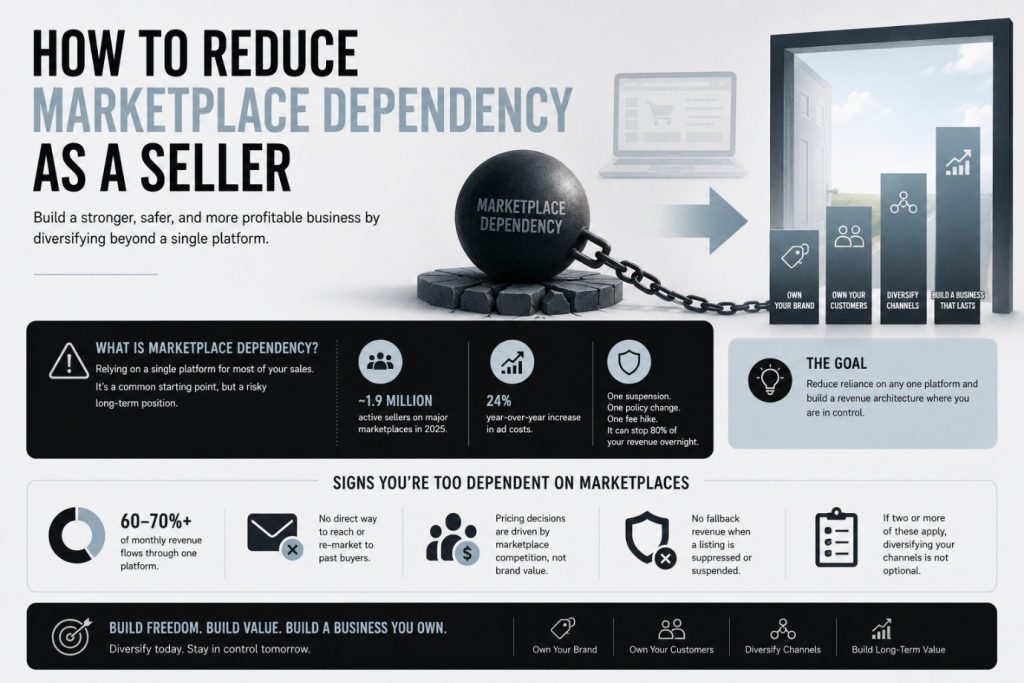
What Is Marketplace Dependency (and Why It’s Risky)?
Marketplace dependency means relying on one platform, most commonly Amazon, for most of your sales. It is a natural starting point, but a structurally fragile long-term position.
The reason to sell outside Amazon and other dominant platforms isn’t philosophical. It’s financial. With approximately 1.9 million active sellers competing on Amazon as of 2025 and advertising costs rising 24% year-over-year, the cost of visibility keeps climbing while organic reach keeps shrinking. A suspension, a fee hike, or an algorithm change isn’t an inconvenience when 80% of your revenue lives on one platform. It is an emergency.
Signs You’re Too Dependent on Marketplaces
- Over 60-70% of monthly revenue flows through one platform
- No direct way to reach or re-market to past buyers
- Pricing decisions are driven by marketplace competition, not brand value
- No fallback revenue when a listing is suppressed or suspended
If two or more of these apply, diversifying your ecommerce channels is not optional. It is the need of the hour.

The 4-Step Framework to Reduce Marketplace Dependency
Step 1: Add a Secondary Sales Channel
The most important first move when learning how to reduce marketplace dependency is launching a second revenue channel in parallel, not instead of your existing marketplace. This is where your D2C transition strategy begins.
Option: Aserium as a structured, lower-friction starting point. Aserium’s hybrid model gives sellers built-in buyer discovery and fulfillment support without the full infrastructure investment a standalone store requires. For sellers who are 80-90% marketplace dependent today, Aserium is the most accessible first step toward independence. Launch imperfectly. Optimize in motion.
Step 2: Start Capturing Customer Data
Every sale through an independent channel is a data asset that belongs to you. On a marketplace, that opportunity disappears entirely. The platform owns the customer relationship, not the seller.
Start with email. Ecommerce stores with strong email programs see 40-52% repeat purchase rates, compared to 12-18% without. That gap is the economic difference between a retention-powered business and one that constantly re-acquires the same customers at rising cost. A simple post-purchase email sequence and a welcome offer on your independent channel is enough to start building an owned audience that no marketplace can charge you to reach.
Step 3: Build Traffic Outside Marketplaces
An independent channel without traffic is just infrastructure. Three channels to develop as part of your multi-channel selling strategy:
- SEO Content: Targeting buyer-intent keywords generates compounding organic traffic that doesn’t require ongoing ad spend. A well-ranked page can drive consistent revenue for years.
- Paid Social: Meta and TikTok ads let you test product messaging and audiences on your own terms. Social commerce revenue is projected to reach $6.2 trillion globally by 2030. Buyer intent on these platforms is real and growing.
- Email Re-marketing: Once you’ve captured customer data, this becomes your lowest-cost, highest-converting channel for repeat purchases and upsells.
Step 4: Shift Revenue Gradually
Reducing marketplace dependency is a measured transition, not a single decision. A realistic progression for most sellers:
| Phase | Marketplace Revenue | Independent Revenue | Timeline |
| Start | 90% | 10% | Now |
| Phase 1 | 70% | 30% | 3–6 months |
| Phase 2 | 50% | 50% | 6–12 months |
| Phase 3 | 30–40% | 60–70%+ | 12–24 months |
Moving from 90% to 70% marketplace reliance is the critical milestone. It’s where independent channels start generating enough momentum to become self-reinforcing through effective multi-channel selling.
Best Marketplace Alternatives for Sellers
Choosing the right marketplace alternatives for sellers depends on your product, audience, and how much infrastructure you’re ready to manage.
- D2C Store (Shopify): Full ownership of customer data, brand experience, and margins. Best for sellers with a traffic strategy already in motion.
- Social Commerce (TikTok Shop, Instagram Shopping): Algorithm-driven discovery with low setup friction. Works best for visual and lifestyle products targeting younger buyers.
- Niche Platforms: Category-specific marketplaces like Etsy or Faire bring qualified buyer intent with lower competition than broad platforms.
- Aserium: Built specifically for sellers who want to reduce marketplace dependency without starting from scratch. Aserium combines buyer discovery, brand control tools, and fulfillment support in a model that sits between full marketplace dependency and standalone D2C, making it the most practical bridge for sellers in active transition.
Metrics to Track During the Transition
Three numbers tell you whether your multi-channel selling strategy is working:
- CAC by channel: Track customer acquisition cost per channel separately. Your goal is a downward trend as owned and organic channels mature over time.
- LTV:CAC ratio: A healthy benchmark is above 3:1. Customers acquired through email and organic search consistently deliver higher lifetime value than paid marketplace traffic.
- Channel revenue split: Your monthly dependency gauge. If marketplace share is declining month over month, the strategy is working, even if the numbers are still skewed early on.
Why Most Sellers Fail to Reduce Dependency
Three consistent failure points explain why most sellers stay stuck when trying to reduce marketplace dependency:
- No traffic plan: A Shopify store without a systematic acquisition strategy generates no revenue and gets abandoned. The channel isn’t the problem. The missing traffic engine is.
- Too many channels at once: Launching five channels simultaneously means none receives the focus needed to perform. Go sequential: one channel, executed properly, then the next.
- Underestimating ramp time: Independent channels take 6–12 months to reach meaningful contribution. Sellers who treat this as a 30-day experiment run out of patience before the compounding effect begins.
Sellers who successfully reduce marketplace dependency treat it as a 12–24 month operational project, not a quick fix.
How Aserium Helps Sellers Reduce Marketplace Dependency
Aserium is purpose-built for sellers at this exact stage of their business.
- Own your data: Unlike traditional marketplaces, Aserium gives sellers direct access to customer data, the foundation of every retention program, re-marketing campaign, and email strategy you’ll build from here.
- Maintain control: Brand Registry features let you manage your pricing, positioning, and brand presentation without algorithm-driven suppression or rigid listing templates that strip out your identity.
- Still access the market: You don’t have to sacrifice distribution to gain independence. Aserium’s buyer discovery infrastructure delivers real market access without the platform risk that comes with putting all your revenue in someone else’s hands.
For sellers serious about building a channel-independent business and learning how to reduce marketplace dependency effectively, Aserium is the structured, supported starting point. Less friction than going fully D2C from day one. More independence than staying on Amazon alone.
Conclusion
The path to reducing marketplace dependency is clear: add one independent channel, capture customer data from every sale, build traffic you own, and shift revenue gradually over 12–24 months through smart multi-channel selling.
Start with a single step today, because the sellers who begin their D2C transition strategy now are the ones who will own something genuinely theirs two years from now.
Ready to stop depending on one platform and start building something that’s truly yours?
Never settle for less.