
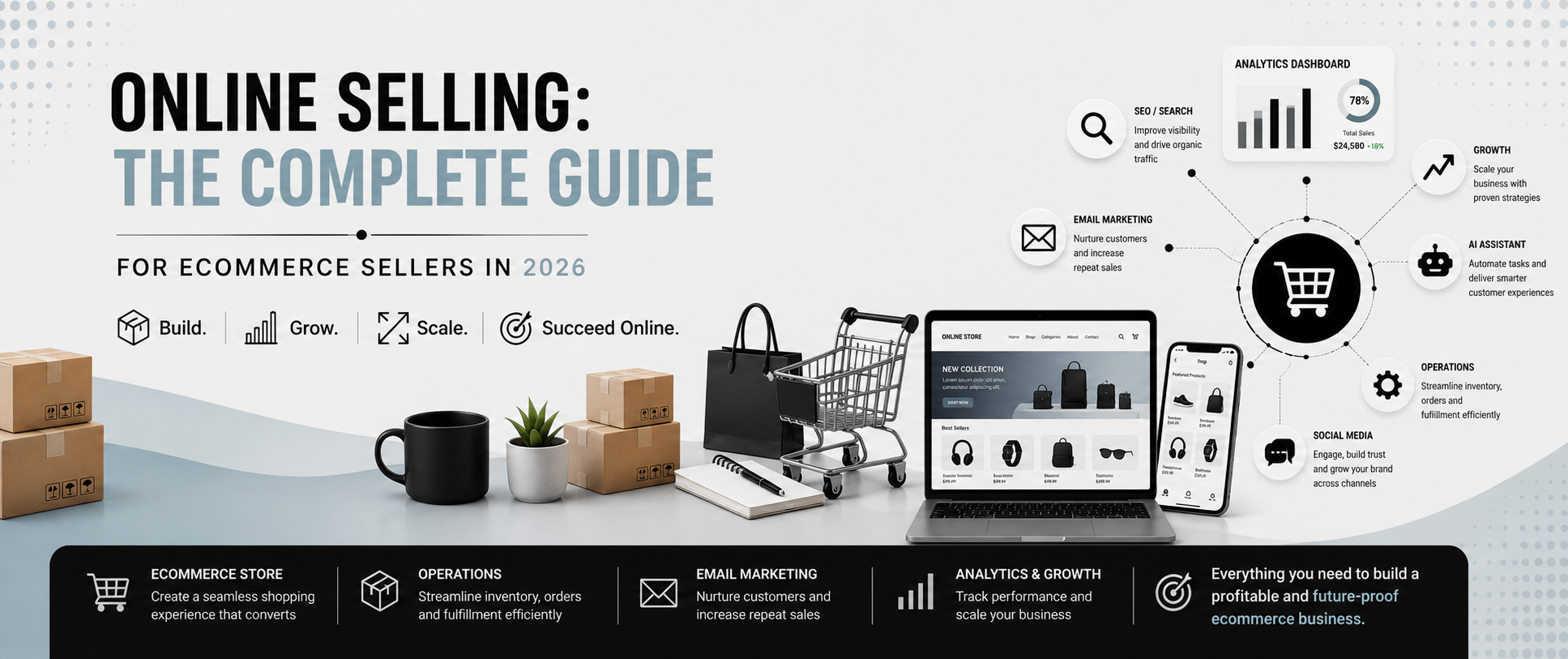
The Complete Online Selling Guide for eCommerce Sellers (2026)
Last Update
Author

How Aserium Helps Sellers
Many online sellers struggle with high marketplace fees, limited brand control, and restricted access to customer data. Aserium’s hybrid commerce platform helps businesses overcome these challenges while supporting long-term growth.
Key Benefits
- ✓ Build a branded online store
- ✓ Sell across multiple channels
- ✓ Own your customer relationships
- ✓ AI-powered shopping experiences
- ✓ Unified seller dashboard
Whether you’re launching your first online business or scaling an established brand, choosing the right selling strategy has never been more important. Today’s sellers have more opportunities than ever from marketplaces and branded websites to social commerce and hybrid models. At the same time, rising competition and acquisition costs make long-term success harder to sustain.The most successful ecommerce businesses don’t rely on a single sales channel. Instead, they build a diversified strategy that combines marketplace visibility with brand ownership, direct customer relationships, and sustainable traffic reducing risk while increasing control over pricing, experience, and profitability.This guide brings together the essential strategies every seller should understand: choosing the right sales channels, building a recognizable brand, improving margins, reducing marketplace dependency, attracting qualified customers, and scaling sustainably. Whether you sell through Amazon, Walmart Marketplace, Shopify, social commerce, or multiple channels, the principles here will help you build a stronger business.
Quick Summary
If you’re short on time, here are the most important takeaways:
- Build your business around multiple sales channels instead of relying on a single marketplace.
- Invest in your brand, customer relationships, and first-party customer data.
- Develop a pricing strategy that protects both competitiveness and profitability.
- Reduce operating costs without sacrificing customer experience.
- Create sustainable traffic through SEO, email marketing, and social commerce.
- Measure long-term success using profitability, customer lifetime value, and revenue diversification — not just total sales.
- Continue adapting to emerging trends such as AI-powered shopping, personalization, and omnichannel commerce.
By following these principles, sellers can build a business that is more resilient, more profitable, and better positioned for long-term growth.
Editor’s Note:
This guide is designed to help eCommerce sellers make informed decisions, regardless of the platform they choose. Throughout the guide, we’ll also share practical examples of how modern commerce platforms such as Aserium help sellers reduce marketplace dependency, build their own brand, and grow across multiple sales channels.
Chapter 1: What Is Online Selling?
Online selling is the process of marketing and selling products or services through digital channels such as ecommerce websites, marketplaces, social commerce platforms, and mobile apps. Unlike traditional retail, it lets businesses reach customers across cities, states, and even international markets without a physical storefront.
Successful online selling has evolved far beyond simply listing products on a marketplace. Today’s businesses compete on customer experience, pricing, brand trust, product quality, fulfillment speed, and post-purchase engagement. Sellers who build strong foundations in these areas are far more likely to achieve sustainable growth than those relying on one channel.
Online Selling Has Changed
A decade ago, many businesses could succeed by listing products on a major marketplace and waiting for customers to find them. While marketplaces remain important, competition has increased significantly and customer acquisition has become more expensive.
Today’s successful sellers focus on building businesses rather than simply managing listings. They invest in multiple traffic sources, create memorable brands, collect first-party customer data, and develop relationships that encourage repeat purchases often combining several channels, including:
- Online marketplaces for customer discovery.
- Branded ecommerce websites for customer ownership.
- Social commerce platforms for engagement and impulse purchases.
- Email marketing for customer retention.
- Organic search (SEO) for long-term traffic growth.
- Paid advertising to accelerate customer acquisition.
This multi-channel approach helps reduce business risk while creating more opportunities for sustainable growth.
Why More Sellers Are Moving Beyond a Single Marketplace
Marketplaces provide access to millions of active shoppers and can be an excellent way to launch or expand a business. But relying exclusively on one platform creates vulnerability to factors outside your control, including algorithm updates that affect visibility, policy or fee changes, limited access to customer information, and greater competition within search results.
Rather than abandoning marketplaces, many successful sellers treat them as one part of a broader strategy gradually investing in owned channels with greater control over branding, customer relationships, and pricing.
Related Guide: Learn how to build a more resilient business in our guide on How to Reduce Marketplace Dependency as a Seller.
The Four Primary Online Selling Models
Choosing the right selling model depends on your goals, resources, and stage of business growth. Most ecommerce businesses fall into one of four categories.
| Selling Model | Best For | Key Advantages | Considerations |
| Online Marketplaces | New sellers seeking quick market access | Built-in traffic, faster launch, established buyer trust | Limited customer ownership, platform fees, strong competition |
| Branded Ecommerce Website | Businesses focused on long-term growth | Full control over branding, customer data, and pricing | Requires marketing to generate traffic |
| Social Commerce | Visual and lifestyle brands | Strong engagement, influencer partnerships, direct purchasing | Platform trends and algorithms can change quickly |
| Hybrid Selling | Growing businesses | Diversified revenue, broader customer reach, reduced business risk | Requires coordinated inventory, marketing, and operations |
For many businesses, the hybrid approach offers the greatest flexibility because it balances marketplace visibility with the long-term advantages of owning customer relationships and building an independent brand.
What Makes an Online Selling Business Successful?
Success in ecommerce is no longer measured only by sales volume. Sustainable businesses focus on building systems that keep generating value over time. Successful sellers typically diversify revenue across channels, invest in retention rather than relying solely on new customer acquisition, use data to guide pricing and marketing decisions, build trust through consistent branding, create content that attracts customers through search and social, and monitor profitability, lifetime value, and repeat purchase rates. These businesses adapt more easily to changing conditions because they aren’t dependent on a single platform.
The Role of AI in Modern Online Selling
Artificial intelligence is reshaping ecommerce by helping businesses automate repetitive tasks, improve customer experiences, and make better data-driven decisions. Today, AI is commonly used to recommend products, improve search and discovery, automate customer support, predict inventory demand, personalize email campaigns, and generate marketing content more efficiently. Rather than replacing sellers, AI enables businesses to operate more efficiently while delivering more personalized shopping experiences.
Key Takeaways
Online selling is no longer about choosing between a marketplace and your own website. The strongest ecommerce businesses combine multiple channels to reach customers while steadily increasing control over their brand, customer relationships, and long-term growth.
Chapter 2: Different Ways to Sell Online
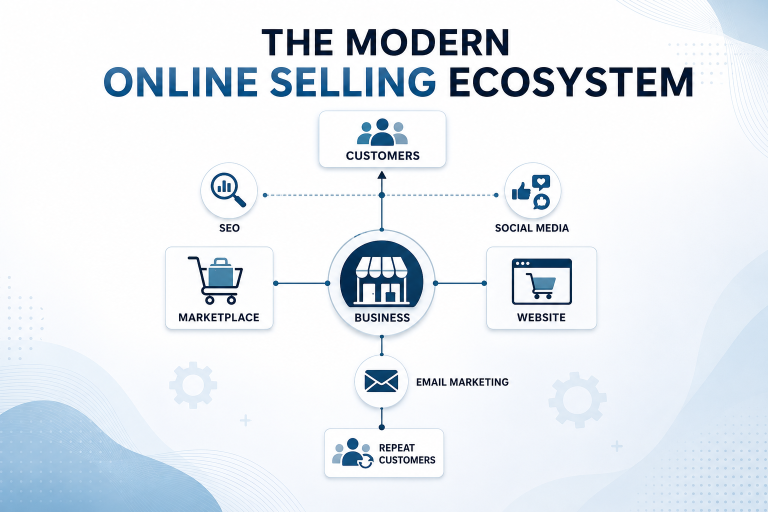
There is no single “best” way to sell online. The right strategy depends on your goals, product category, budget, audience, and growth plans and many successful sellers eventually combine multiple channels to create a balanced, resilient business.
1. Selling Through Online Marketplaces
Online marketplaces are often the first choice for new sellers because they provide immediate access to an established customer base rather than requiring you to attract your own traffic.
Advantages: Fast, simple setup; built-in traffic and buyer trust; integrated payment processing and fulfillment options.
Challenges: Limited control over customer relationships; fees that reduce margins; strong competition and dependence on marketplace algorithms.
Marketplaces are excellent for validating products and generating initial sales, but many businesses eventually look for additional channels to improve customer ownership and profitability.
2. Building Your Own Ecommerce Website
A branded ecommerce website gives you complete control over how products are presented, how customers interact with your brand, and how marketing is managed. Unlike marketplaces, your website becomes a long-term asset that grows in value as your brand and organic traffic increase.
Advantages: Complete ownership of customer relationships and full branding control; greater pricing flexibility and better retention opportunities.
Challenges: You’re responsible for generating traffic; marketing, optimization, and building trust all require ongoing investment.
A standalone ecommerce website is often the foundation of a sustainable long-term growth strategy.
Related Guide: Selling on Amazon vs Building Your Own Brand
3. Selling Through Social Commerce
Social commerce allows customers to discover and purchase products directly through social media, using engaging content to encourage purchasing while customers browse their feeds. This works particularly well for visually appealing products and brands with active online communities.
Advantages: High engagement and strong product discovery; influencer marketing opportunities and support for impulse purchases.
Challenges: Platform algorithms constantly evolve and organic reach can fluctuate; sales often depend heavily on audience engagement.
Social commerce works best when integrated into a broader multichannel strategy rather than used as the only revenue source.
4. Hybrid Selling
Hybrid selling combines the strengths of multiple channels instead of relying on a single platform for example, selling on marketplaces for acquisition, operating a branded website, promoting through social commerce, using email marketing for repeat purchases, and driving long-term traffic through SEO. Rather than competing against each other, these channels support different stages of the customer journey.
Comparing the Four Selling Models
| Feature | Marketplace | Ecommerce Website | Social Commerce | Hybrid Selling |
| Speed to Launch | Excellent | Moderate | Fast | Moderate |
| Customer Ownership | Low | High | Medium | High |
| Brand Control | Limited | Complete | Moderate | High |
| Built-in Traffic | High | Low | Medium | Medium |
| Profit Margin Potential | Medium | High | Medium | High |
| Long-Term Business Value | Medium | High | Medium | Excellent |
No single model is perfect each serves a different purpose depending on your business objectives.
Which Selling Model Is Right for You?
| If You Are… | Recommended Starting Point |
| Launching your first product | Marketplace |
| Growing an existing brand | Hybrid Selling |
| Building a premium brand | Ecommerce Website |
| Selling visually appealing products | Social Commerce |
| Expanding internationally | Hybrid Selling |
| Looking for long-term business stability | Hybrid Selling with a strong branded website |
For many ecommerce businesses, hybrid selling provides the best balance between customer acquisition, brand building, and long-term growth.
Expert Insight
Successful sellers rarely rely on a single channel forever. They use marketplaces to reach new customers, their own website to build lasting relationships, and channels like SEO, email, and social media to create predictable, diversified revenue. The goal isn’t to replace one platform with another it’s to build a business where no single channel determines your success.
Key Takeaways
Every online selling model offers unique advantages, but each also has limitations. The most resilient ecommerce businesses combine multiple channels to reduce risk, strengthen customer relationships, and increase control over their brand.
Chapter 3: How to Choose the Right Selling Model
Selecting the right selling model affects everything from customer acquisition and operating costs to branding and long-term scalability. There’s no universal solution instead of asking “Which platform is best?” ask “Which model best supports my business goals?”
Step 1: Define Your Primary Goal
| Business Goal | Recommended Selling Model |
| Launch quickly | Online Marketplace |
| Build a long-term brand | Branded Ecommerce Website |
| Reach younger audiences | Social Commerce |
| Balance growth and ownership | Hybrid Selling |
Your selling model should support your business strategy not determine it.
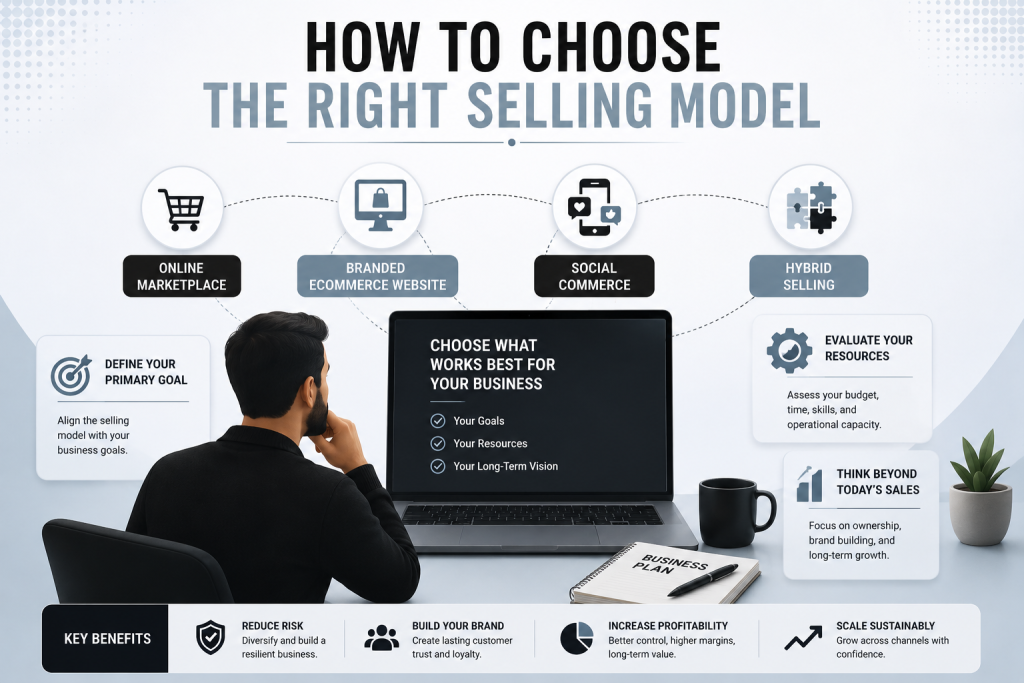
Step 2: Evaluate Your Resources
Consider what you currently have: a marketing budget, capacity to invest in SEO and content, time to build a brand, comfort managing customer service, and reliable order fulfillment. Your answers will help narrow the most suitable approach.
Step 3: Think Beyond Today’s Sales
While early sales matter, sustainable businesses are built by thinking years ahead. Ask whether you’ll own your customer relationships, whether you can build a recognizable brand, how much pricing control you’ll have, and whether the platform supports future international expansion and revenue diversification.
Decision Framework
| If You… * | *Recommended Approach** |
| Are launching your first ecommerce business | Start with a marketplace while planning your long-term brand strategy |
| Already have consistent marketplace sales | Expand into a hybrid model by adding an independent sales channel |
| Have an established customer base | Invest in your branded ecommerce website and customer retention |
| Want to reduce business risk | Diversify revenue across multiple channels |
| Want complete control over your business | Build your brand around owned channels supported by marketplaces where appropriate |
Common Mistakes When Choosing a Selling Model
- Choosing a platform solely because competitors use it.
- Depending on a single marketplace for most of your revenue.
- Ignoring customer ownership and first-party data.
- Measuring success only by sales instead of profitability and customer lifetime value.
Expert Insight
The strongest ecommerce businesses combine multiple channels based on the role each plays in the customer journey: marketplaces drive discovery, branded websites build long-term relationships, and channels like SEO and email increase customer lifetime value.
Action Checklist
- Define your business goals and review available resources.
- Estimate your marketing budget and identify your target audience.
- Decide how important customer ownership is to your business.
- Create a one-year and three-year growth plan.
- Choose one primary selling model and one secondary growth channel.
Continue Your Learning
Chapter 4: Building a Profitable Ecommerce Business
Generating more sales is only one part of building a successful ecommerce business. Long-term success depends on profitability and efficient operations many sellers grow revenue year after year but struggle to improve their bottom line because costs rise just as fast. A profitable business increases the value of every customer, controls expenses, optimizes pricing, and makes decisions based on data rather than assumptions.
The Four Pillars of Ecommerce Profitability
1. Revenue Growth
Revenue matters because it creates room for expansion, but growth should come from attracting qualified customers and increasing repeat purchases rather than relying on discounts or aggressive advertising. Focus on new sales channels, higher average order value (AOV), repeat purchases, complementary products, and better conversion rates.
2. Cost Management
Every unnecessary expense reduces your margin. Common costs include marketplace fees, advertising, shipping, packaging, payment processing, returns, software, and inventory storage. Review each expense to determine whether it contributes to customer satisfaction or growth, rather than making broad cuts.
Continue Reading: How to Reduce Ecommerce Costs and Increase Profit Margins
3. Smart Pricing Strategy
Many sellers reduce prices simply to win more sales, but frequent discounting often lowers perceived value and margins. Instead, consider value-based pricing, product bundling, tiered options, limited-time promotions, and premium positioning for differentiated products.
Continue Reading: Ecommerce Pricing Guide: How US Sellers Can Protect Their Margins
4. Customer Retention
Acquiring a new customer usually costs significantly more than selling to an existing one. Repeat customers spend more, purchase more frequently, require lower marketing investment, and recommend your business to others. Improving retention through excellent service, email marketing, loyalty programs, and personalized experiences can have a greater impact on profitability than constantly increasing ad spend.
Key Metrics Every Seller Should Monitor
| Metric | Why It Matters |
| Gross Profit Margin | Measures product profitability before operating expenses. |
| Net Profit Margin | Shows overall business profitability after all costs. |
| Average Order Value (AOV) | Indicates how much customers spend per transaction. |
| Customer Lifetime Value (CLV) | Measures long-term customer value. |
| Customer Acquisition Cost (CAC) | Calculates the cost of acquiring each new customer. |
| Return Rate | Identifies potential product or customer experience issues. |
| Repeat Purchase Rate | Measures customer loyalty and retention. |
| Conversion Rate | Indicates how effectively visitors become customers. |
Signs Your Business Is Growing Profitably
Growth is healthy when revenue rises consistently, margins hold steady or improve, acquisition costs stay controlled, repeat purchase rates climb, and revenue becomes more diversified. If sales grow while margins decline, pricing or operational costs likely need attention.
Common Profitability Mistakes
- Competing only on price and ignoring customer retention.
- Overspending on paid advertising without measuring ROI.
- Failing to review operating expenses regularly.
- Depending on a single revenue source.
- Making pricing decisions without understanding product margins.
Expert Insight
The highest-performing businesses don’t simply sell more they build systems that increase the value of every customer over time, balancing revenue growth with operational efficiency, retention, and strategic pricing rather than discounts or short-term spikes.
Action Checklist
- Calculate your gross and net profit margins; review advertising ROI.
- Audit recurring operating expenses and measure CAC.
- Monitor customer lifetime value and increase AOV through bundles.
- Develop a customer retention strategy and review pricing quarterly.
- Diversify revenue across multiple sales channels.
Continue Your Learning
Chapter 5: Ecommerce Pricing Strategy Protecting Your Margins While Staying Competitive
Pricing is one of the most influential decisions an ecommerce seller makes. Price too low and you may boost revenue while eroding profitability; price too high without demonstrating value and customers may choose a competitor. Successful sellers treat pricing as an ongoing strategy reviewing costs, demand, and competitor activity regularly rather than a one-time decision. The goal isn’t to be the cheapest seller, but to deliver value while maintaining healthy margins.
What Influences Ecommerce Pricing?
A sustainable pricing strategy considers cost of goods sold, marketplace and payment processing fees, shipping and fulfillment expenses, marketing costs, return and warranty costs, desired profit margin, competitor pricing, and customer perception of value. Ignoring any of these factors can reduce profitability even as sales increase.
Common Ecommerce Pricing Strategies
| Pricing Strategy | Best For | Key Benefit |
| Cost-Plus Pricing | New businesses | Simple and predictable pricing model |
| Value-Based Pricing | Premium or differentiated products | Maximizes perceived value and margins |
| Competitive Pricing | Highly competitive markets | Helps remain competitive without unnecessary discounting |
| Bundle Pricing | Complementary products | Increases average order value |
| Tiered Pricing | Product variations | Appeals to different customer segments |
| Promotional Pricing | Seasonal campaigns | Encourages short-term demand |
Why Competing Only on Price Is Risky
Pricing is one of the most influential decisions an ecommerce seller makes. Price too low and you may boost revenue while eroding profitability; price too high without demonstrating value and customers may choose a competitor. Successful sellers treat pricing as an ongoing strategy reviewing costs, demand, and competitor activity regularly rather than a one-time decision. The goal isn’t to be the cheapest seller, but to deliver value while maintaining healthy margins.
How to Protect Your Profit Margins
Review supplier costs regularly, negotiate better terms as volumes grow, cut unnecessary operational expenses, improve inventory management, encourage larger orders through bundles, and continuously evaluate advertising ROI. Protecting margins isn’t about charging more it’s ensuring every sale supports long-term success.
Pricing Mistakes Ecommerce Sellers Should Avoid
- Copying competitor prices without understanding your own costs.
- Ignoring marketplace fees and shipping expenses.
- Leaving prices unchanged despite rising costs.
- Running continuous discounts that train customers to wait for sales.
- Measuring success only by revenue instead of profit.
Expert Insight
The strongest ecommerce brands rarely compete on price alone they compete on trust, product quality, customer experience, and overall value. A well-defined pricing strategy reflects the value your business delivers while generating the profit needed for long-term growth.
Action Checklist
- Calculate your true cost per order and review all fees.
- Measure gross profit margin and compare competitor pricing quarterly.
- Test product bundles and upsell opportunities.
- Evaluate discount campaigns based on profitability, not just sales volume.
- Update pricing whenever significant costs change.
Chapter 6: Reducing Marketplace Dependency Without Sacrificing Growth
Online marketplaces have transformed ecommerce by giving businesses access to millions of potential customers, and for many sellers they remain the fastest way to launch and generate consistent sales. But relying too heavily on one marketplace creates long-term risk. Reducing dependency doesn’t mean abandoning marketplaces it means making them one part of your growth strategy rather than your only source of revenue.
What Is Marketplace Dependency?
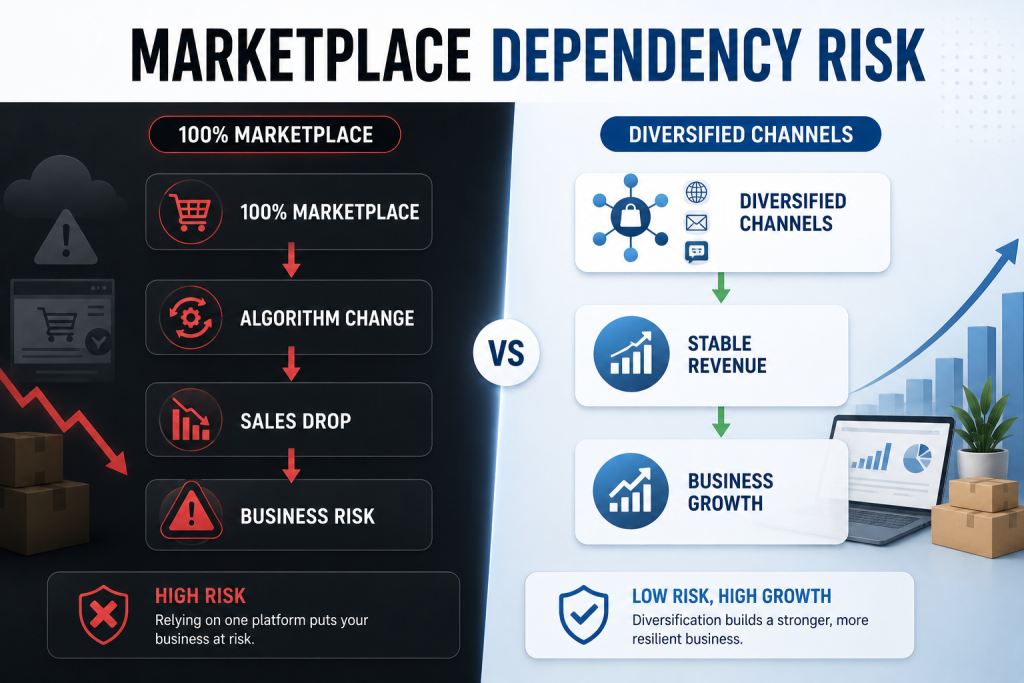
Marketplace dependency occurs when the majority of your revenue comes from a single platform, which also influences your visibility, customer acquisition, pricing flexibility, and ability to communicate directly with buyers. Businesses that diversify across multiple channels are generally better positioned to adapt to changing conditions.
Why Diversification Matters
A balanced strategy helps you build direct customer relationships, collect first-party data, strengthen brand identity, increase repeat purchases, and create more predictable revenue.
A Practical Diversification Roadmap
Moving beyond a single marketplace doesn’t need to happen overnight. Many successful sellers follow a gradual approach:
Stage 1: Build a Strong Marketplace Foundation
Continue using marketplaces to generate consistent sales while refining products, service, and fulfillment.
Stage 2: Launch an Independent Sales Channel
Create an additional channel for greater control over branding and customer relationships, such as a branded website, hybrid platform, social commerce, or B2B/wholesale partnerships.
Stage 3: Build Your Own Audience
Invest in owned marketing channels including SEO, email marketing, educational content, social communities, and referral programs, which gradually reduce dependence on paid marketplace traffic.
Stage 4: Optimize and Scale
Track performance across every channel and keep investing in those delivering the strongest long-term profitability. The goal isn’t equal revenue from every channel it’s ensuring no single platform determines your business success.
Comparing Marketplace-Dependent and Diversified Businesses
Business Area | Marketplace-Dependent Seller | Diversified Ecommerce Business |
Revenue Sources | Primarily one platform | Multiple sales channels |
Customer Ownership | Limited | High |
Brand Control | Restricted | Complete |
Marketing Flexibility | Limited | High |
Business Risk | Higher | Lower |
Long-Term Scalability | Moderate | High |
Signs You’re Ready to Expand Beyond One Marketplace
You may be ready to diversify if most of your revenue comes from one marketplace, advertising costs keep rising, margins are harder to maintain, you want stronger customer relationships, or you’re planning new product lines. These signs don’t mean you should stop selling on marketplaces they suggest it’s time to expand your overall strategy.
Expert Insight
The strongest ecommerce businesses don’t choose between marketplaces and independent selling they combine both. Marketplaces help acquire customers, while owned channels build long-term relationships, loyalty, and resilience.
Action Checklist
- Identify the percentage of revenue from each sales channel.
- Set a target to reduce reliance on a single platform over time.
- Launch one additional sales channel and begin collecting first-party data.
- Develop an SEO and content marketing strategy, and build an email program.
- Review channel performance every quarter.
Continue Your Learning
Quick FAQs
Should I stop selling on marketplaces?
No. Marketplaces can remain an important acquisition channel. The goal is to reduce overdependence by developing additional revenue sources and stronger customer relationships.
How long does it take to reduce marketplace dependency?
Most businesses see meaningful progress over 6–24 months. Diversification is a long-term strategy, not a one-time project.
Chapter 7: Marketing & Customer Acquisition How to Grow Your Ecommerce Business
Launching an online store is only the beginning. Sustainable growth depends on consistently attracting qualified visitors, converting them into customers, and encouraging repeat purchases. Many businesses struggle because they rely on a single marketing channel if advertising costs rise or algorithms change, sales can decline overnight. The strongest businesses reduce this risk with a balanced strategy combining owned, earned, and paid channels.
The Customer Acquisition Funnel
Stage | Customer Goal | Recommended Marketing Channels |
Awareness | Discover products and brands | SEO, social media, PR, content marketing |
Consideration | Compare products and options | Product pages, buying guides, reviews, email |
Purchase | Complete the order | Optimized checkout, promotions, trust signals |
Retention | Buy again | Email marketing, loyalty programs, customer support |
Advocacy | Recommend your brand | Referral programs, reviews, user-generated content |
Successful marketing supports every stage not just the purchase.
1. Search Engine Optimization (SEO)
SEO is one of the most sustainable ways to attract customers because it brings people to your site when they’re actively searching delivering long-term traffic, lower acquisition costs, and compounding results as your content library grows. This should include product and category page optimization, educational blog content, internal linking, technical SEO, and local SEO where applicable.
2. Content Marketing
Customers rarely purchase immediately after discovering a product. Educational content buying guides, product comparisons, tutorials, FAQs, and case studies helps answer questions, build trust, and position your brand as a helpful resource. A well-planned content strategy also strengthens SEO.
3. Email Marketing
Email remains one of the highest-return marketing channels because it allows direct communication with existing customers, through welcome emails, cart abandonment reminders, product recommendations, newsletters, replenishment reminders, and loyalty rewards. Unlike paid advertising, your email list is an owned asset that continues delivering value over time.
4. Social Media & Social Commerce
Social platforms increase visibility, engage customers, and showcase products authentically through short-form videos, behind-the-scenes content, testimonials, demonstrations, user-generated content, and live shopping events. Focus on content that answers customer questions and demonstrates product value rather than posting constantly.
5. Paid Advertising
Paid advertising search, shopping, social, display remarketing, and video can accelerate growth when campaigns are carefully managed. Monitor ROI closely to ensure advertising contributes to profitability rather than simply increasing revenue.
Why Customer Retention Matters
Many businesses focus heavily on acquiring new customers while overlooking existing ones, even though repeat buyers spend more, purchase more frequently, trust your brand, and cost less to market to. Improving customer experience, offering responsive support, and maintaining consistent communication all strengthen retention.
Marketing Metrics Every Seller Should Track
Metric | Why It Matters |
Organic Traffic | Measures SEO performance |
Conversion Rate | Indicates website effectiveness |
Customer Acquisition Cost (CAC) | Shows marketing efficiency |
Customer Lifetime Value (CLV) | Measures long-term customer value |
Email Open Rate | Evaluates email engagement |
Repeat Purchase Rate | Measures customer loyalty |
Return on Ad Spend (ROAS) | Tracks advertising profitability |
Average Order Value (AOV) | Measures purchasing behavior |
Expert Insight
The most successful ecommerce businesses don’t rely on one traffic source. They build a marketing system where SEO attracts new visitors, content builds trust, email strengthens relationships, social media increases engagement, and paid advertising accelerates growth when needed.
Action Checklist
- Develop an SEO content plan and publish educational content consistently.
- Build and grow your email subscriber list; improve product page conversion rates.
- Monitor customer acquisition costs and launch retention campaigns.
- Track marketing performance monthly and test each channel.
Quick FAQs
Which marketing channel should ecommerce businesses prioritize first?
Focus on building a foundation with SEO, content marketing, and email marketing. These owned channels deliver value over time, while paid advertising can accelerate growth when budgets allow.
How long does ecommerce SEO take to produce results?
SEO is a long-term strategy. Many businesses see measurable improvements within a few months, with stronger results coming from consistent content and technical SEO improvements over time.
Chapter 8: Scaling Your Ecommerce Business Without Losing Control
Growing an ecommerce business is exciting, but scaling successfully requires more than increasing sales. As order volumes grow, businesses face new challenges in operations, support, inventory, fulfillment, and financial planning many sellers discover that higher revenue doesn’t always mean higher profits. Sustainable scaling means building systems that serve more customers while maintaining quality, experience, and profitability.
What Does Scaling Really Mean?
Scaling is the ability to increase revenue faster than operating costs. A scalable business can handle higher order volumes efficiently, maintain healthy margins, deliver a consistent customer experience, expand into new markets, and launch additional product lines without significantly increasing manual work.
Build Systems Before You Need Them
Many businesses wait until problems appear before improving processes. Successful sellers standardize inventory management, fulfillment, support workflows, product data, marketing automation, and financial reporting in advance documented processes reduce errors and make it easier to onboard new team members as the business expands.
Diversify Your Revenue Streams
Businesses that rely on a single product or channel face greater risk. Consider expanding through additional or complementary product categories, subscription or replenishment models, B2B and wholesale opportunities, international markets, new ecommerce channels, and strategic partnerships.
Invest in Customer Retention
As acquisition costs increase, retaining existing customers becomes increasingly valuable through loyalty programs, personalized recommendations, educational email campaigns, responsive support, exclusive offers, and subscription services where appropriate.
Automate Repetitive Tasks
Automation allows businesses to grow without increasing manual workload at the same pace. Consider automating order confirmations, inventory updates, customer segmentation, review requests, marketing campaigns, reporting dashboards, and product feed synchronization freeing your team to focus on customer experience and strategy.
Monitor the Right Growth Metrics
Metric | Why It Matters |
Revenue Growth | Measures overall business expansion |
Net Profit Margin | Indicates financial health |
Customer Lifetime Value (CLV) | Measures long-term customer value |
Customer Acquisition Cost (CAC) | Shows marketing efficiency |
Repeat Purchase Rate | Reflects customer loyalty |
Average Order Value (AOV) | Measures revenue per transaction |
Inventory Turnover | Indicates inventory efficiency |
Order Fulfilment Time | Tracks operational performance |
Expand into New Markets Carefully
Before launching in a new region, evaluate customer demand, shipping capabilities, local regulations, tax requirements, currency and payment support, competition, and customer support resources. A phased expansion often delivers better long-term results than entering multiple markets at once.
Common Scaling Mistakes
- Expanding too quickly without operational systems, or hiring before defining clear processes.
- Depending on a single marketplace or traffic source.
- Ignoring customer retention and measuring revenue without monitoring profitability.
- Adding too many products too quickly, or delaying technology improvements.
Expert Insight
Businesses that scale successfully focus on building repeatable systems rather than relying on constant manual effort. As operations become more efficient, sellers gain the flexibility to invest in innovation, customer experience, and long-term strategic growth.
Action Checklist
- Document your operational processes and automate repetitive tasks.
- Monitor profitability alongside revenue; diversify your sales channels.
- Expand product offerings strategically and invest in customer retention.
- Review operational performance monthly and plan for market expansion.
Quick FAQs
When should an ecommerce business start scaling?
Focus on scaling after establishing consistent sales, repeatable processes, healthy margins, and reliable customer satisfaction. Scaling too early can create operational challenges that reduce long-term growth.
What is the biggest mistake businesses make while scaling?
Increasing sales without improving operational efficiency. Sustainable scaling requires strong systems, clear processes, and careful monitoring of profitability not just higher revenue.
Chapter 9: The Future of Ecommerce Trends Every Online Seller Should Watch
Ecommerce continues to evolve as technology, consumer expectations, and buying behavior change. While no one can predict the future with certainty, several trends are already reshaping how businesses attract customers and build long-term loyalty. Rather than chasing every new trend, focus on innovations that align with your goals and genuinely improve the customer experience.
1. Artificial Intelligence Will Become a Competitive Advantage
AI is no longer limited to large enterprises. Common applications include product recommendations, support chatbots, personalized email campaigns, product description generation, demand forecasting, and marketing optimization. Treat it as a tool that supports better decisions rather than replaces human expertise.
2. Personalization Will Continue to Drive Conversions
Modern shoppers expect tailored experiences in recommendations, homepage content, offers, email, search results, and loyalty rewards. Even small improvements in personalization can lift satisfaction and repeat purchases.
3. Omnichannel Selling Will Become the Standard
Customers no longer shop through a single channel they may discover a product on social media, compare prices on a marketplace, and buy elsewhere. Successful businesses provide a consistent experience across websites, marketplaces, social commerce, email, and support, focusing on a connected journey rather than managing channels independently.
4. First-Party Customer Data Will Become More Valuable
As privacy regulations evolve and third-party tracking narrows, businesses are placing greater emphasis on collecting first-party data responsibly email subscribers, purchase history, preferences, loyalty participation, and reviews to build more relevant marketing with less reliance on third-party sources.
5. Trust Will Become an Even Bigger Differentiator
With more choices than ever, businesses that build trust through transparent pricing, honest descriptions, authentic reviews, reliable shipping, and clear return policies earn more repeat purchases and long-term loyalty.
6. Sustainability Will Continue to Influence Buying Decisions
Many consumers weigh environmental and ethical factors. Businesses can demonstrate responsible practices through less packaging, more durable products, supply chain transparency, and honest sustainability messaging meaningful improvements, not unsupported claims.
7. Continuous Learning Will Be a Competitive Advantage
The landscape changes rapidly. Successful sellers regularly review performance, test new channels, improve efficiency, invest in training, and adapt based on customer feedback.
What Should Sellers Focus on Today?
Instead of trying to implement every trend immediately, prioritize building a recognizable brand, diversifying your sales channels, improving customer retention, investing in SEO and educational content, using AI to improve efficiency where appropriate, collecting first-party data responsibly, and monitoring profitability alongside revenue.
Expert Insight
Technology will continue to change, but the fundamentals of successful ecommerce remain consistent. Businesses that solve real customer problems, deliver excellent experiences, build trust, and adapt thoughtfully are more likely to achieve sustainable long-term growth than those chasing every new trend.
Action Checklist
- Evaluate where AI can improve efficiency; build stronger first-party customer relationships.
- Strengthen your SEO and content strategy; review your omnichannel selling approach.
- Improve customer retention initiatives and monitor industry trends quarterly.
- Invest in continuous learning and develop a long-term growth roadmap.
Quick FAQs
Will AI replace ecommerce sellers?
No. AI is best viewed as a productivity tool that helps automate tasks, improve personalization, and support better decisions. Human expertise remains essential for strategy, relationships, and brand building.
Which ecommerce trend should businesses prioritize first?
Rather than chasing every emerging technology, focus on strengthening your brand, building direct customer relationships, investing in SEO, and diversifying your sales channels these provide long-term value regardless of future changes.