
You’re Making Sales. But Are You Actually Making Money?
Go ahead, take a second to feel good about those orders rolling in. Seriously, you’ve earned it.
Now here’s the question nobody wants to ask at the party: after platform fees, shipping costs, ad spend, and returns, how much of that revenue is actually landing in your pocket?
For a lot of ecommerce sellers in the US market, the honest answer is: not nearly enough. Revenue looks great on paper. Ecommerce profitability? That’s a whole different conversation. You might be doing $30,000, $50,000, or even $100,000 in monthly sales and still wondering why your bank account barely moved.
This guide is here to change that. Whether you sell on Amazon, Walmart, your own site, or some combination of all three, this ecommerce pricing for sellers’ guide will walk you through how to set prices with real confidence, understand your true ecommerce profit margin, maximize ecommerce profitability, and make smarter decisions about marketplace vs D2C profit.

By the end, you’ll have a clear, actionable framework to stop guessing and start scaling profitably. Let’s dig in.
Why Ecommerce Profitability Matters More Than Revenue
Revenue Is a Vanity Metric. Profit Is What Keeps the Lights On.
There’s a quiet obsession in the ecommerce world with revenue milestones. “I just hit six figures!” gets applause everywhere. And look, it’s genuinely exciting. But revenue without profit isn’t a business. It’s a really expensive hobby.
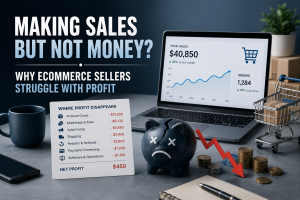
Here’s a scenario that might hit close to home: A seller on a major US marketplace does $50,000 in monthly revenue. After platform commissions (15%), fulfillment fees ($4-$8 per unit), advertising spend (15-20% of revenue), returns (10%), and cost of goods, their net profit might be $2,500-$5,000. That’s a net margin of just 5-10% on what sounds like an impressive number.
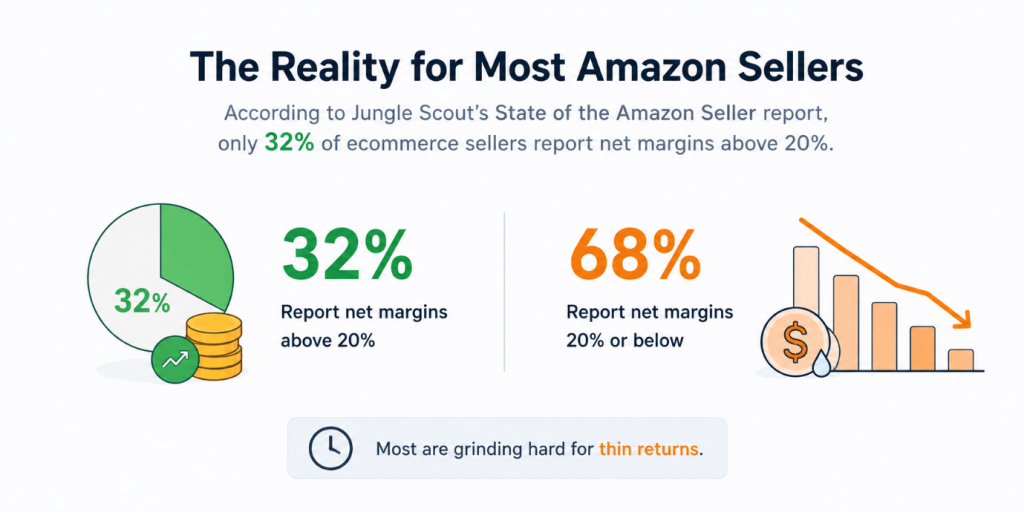
According to Jungle Scout’s State of the Amazon Seller report, only 32% of ecommerce sellers report net margins above 20%. Most are grinding hard for thin returns.
The insight most sellers miss: A business doing $20,000 in monthly revenue with a 25% net margin is more financially healthy than the one doing $50,000 at 5%. Profitability, not revenue, determines whether your business survives and actually scales.
Ecommerce profitability is what lets you reinvest in growth, survive slow seasons, and build something with real equity. The sooner you shift from chasing revenue to protecting margin, the better your outcomes will be. Every. Single. Time.
Understanding Your True Costs: The Foundation of Ecommerce Pricing
You cannot set profitable prices without knowing exactly what it costs you to sell a product. Most sellers underestimate their total cost stack, and that gap is precisely where margins quietly disappear.
The Full Cost Stack Every Ecommerce Seller Should Know
| Cost Component | What It Includes | Typical Range |
| Cost of Goods Sold (COGS) | Product cost, packaging, inbound freight | 30-50% of selling price |
| Shipping and Logistics | Outbound shipping, last-mile delivery, warehouse handling | 8-15% of selling price |
| Platform / Marketplace Fees | Referral fees, listing fees, FBA/fulfillment fees | 8-20% depending on platform |
| Payment Gateway Fees | Credit card processing, transaction fees | 2-3% of transaction value |
| Marketing and Advertising (CAC) | PPC ads, influencer costs, email platforms | 10-25% of revenue |
| Returns and Refunds | Restocking, return shipping, lost inventory | 5-15% depending on category |
| Overhead and Operations | Software, staff, customer service | 3-8% of revenue |
When you add all of this up, total operating costs can easily consume 65-85% of your selling price. That leaves a gross margin of just 15-35% before taxes or reinvestment. Sobering, right?
The Marketplace Fee Trap Nobody Talks About
Platform commissions deserve their own spotlight. On Amazon, referral fees alone range from 6% to 17% depending on category. Layer in FBA fulfillment fees, storage fees, and advertising, and you can easily hand 35-45% of every sale right back to the marketplace.
According to Marketplace Pulse, Amazon sellers pay an average of 34% of their revenue back to the platform in combined fees and advertising costs. That’s not a fee. That’s a business partner who takes a third of everything and doesn’t do the dishes.
This is precisely why more sellers are exploring independent selling platforms that offer lower fee structures and give sellers direct control over their pricing and customer relationships. Platforms like Aserium, purpose-built for the US market, are helping sellers break free from that dependency and keep more of what they earn.
Profit Margin vs. Markup: Know the Difference
One of the most common sources of ecommerce pricing confusion is using “margin” and “markup” interchangeably. They are not the same thing. And mixing them up can cause you to significantly underprice your products without ever realizing it.
Profit Margin
Formula:
Profit Margin (%) = (Selling Price minus Total Costs) divided by Selling Price x 100
Profit margin tells you what percentage of your revenue is actual profit. It’s calculated from your selling price down.
Example: You sell a product for $50. Total cost $35. Profit = $15. Profit margin = 30%.
Markup
Formula: Markup (%) = (Selling Price minus Cost) divided by Cost x 100
Markup is calculated from your cost upward. And here’s the trap: a 50% markup does NOT equal a 50% profit margin.
Example: You buy a product for $35 and mark it up 50%, pricing it at $52.50. Your markup is 50%, but your actual profit margin is only 33%.
For ecommerce sellers, always think in terms of profit margin. It gives you an honest picture of what you’re actually keeping per sale.
The Ideal Ecommerce Pricing Formula
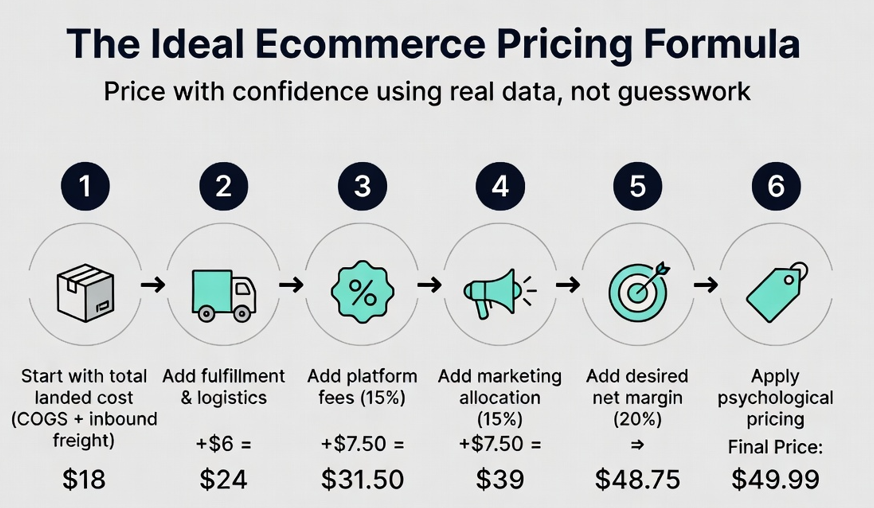
There’s no single “right” price for any product. But there is a systematic approach that ensures every price you set is grounded in real data, not vibes.
Step-by-Step Pricing Framework
Psychological Pricing Basics
Pricing is not purely mathematical. Buyer perception is real and it matters.
A few tactics that actually work:
- Charm pricing ($49.99 vs $50) consistently outperforms in most categories.
- Price anchoring shows a higher “was” price alongside the current price to emphasize value.
- Bundle pricing combines products to lift average order value while keeping per-unit margins healthy.
Marketplace vs D2C Pricing
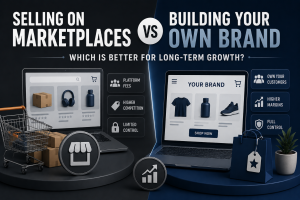
One underrated advantage of selling directly is pricing flexibility. On marketplaces, algorithmic price-matching and competitive pressure make it hard to hold a premium position. When you sell independently, you control the price and the story around it. This is one of the biggest drivers of better marketplace vs D2C profit outcomes for sellers who make the shift.
The Hidden Profit Killers Most Sellers Ignore
Even sellers who price carefully find their margins eroding over time. Here are the silent forces quietly draining your ecommerce profitability:
1. Marketplace Commission Creep
Platform fees are not static. Storage costs rise as you scale. Category rules shift. Sellers who built their pricing model around a fixed fee structure can find themselves underwater when the platform quietly changes terms. And they always change terms.
2.Rising Customer Acquisition Costs (CAC)
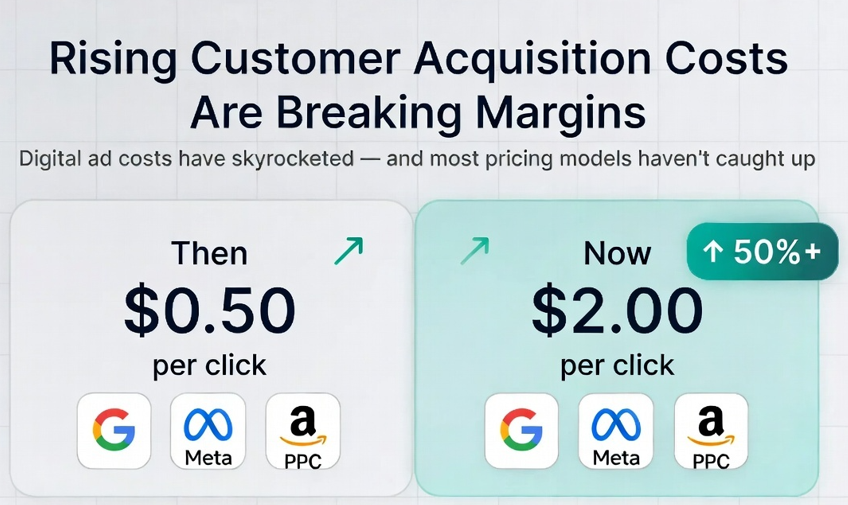
Digital advertising costs have climbed steeply across Google, Meta, and Amazon PPC. According to Tinuiti’s Digital Ad Benchmark Report, average cost-per-click on Amazon Sponsored Products rose over 50%. If your pricing model was built when clicks cost $0.50 and they now cost $2.00, your margin assumptions are broken and you may not even know it yet.
3.Discount Dependency
Promotions drive short-term sales but erode long-term margin. They also train buyers to wait for a sale before purchasing. Sellers who rely on perpetual promotions often find their effective margin is far lower than their listed price suggests.
4.Returns and Their True Cost
The average ecommerce return rate in the US is 16.5%, climbing to 24-30% in apparel categories, per the National Retail Federation’s data. And a 10% return rate sounds manageable until you calculate the real cost: return shipping, restocking labor, damaged inventory, refund processing. Each return can cost 2-4x the value of the refund itself.
5.Lack of Customer Data Ownership
On marketplaces, the customer belongs to the platform. Not you. This means every new sale may require the same acquisition cost as the first one. Without access to your own customer email list or purchase history, lifetime value stays low and repeat purchase rates suffer. It’s one of the most underrated profit killers in the marketplace model.
Where Aserium fits in:
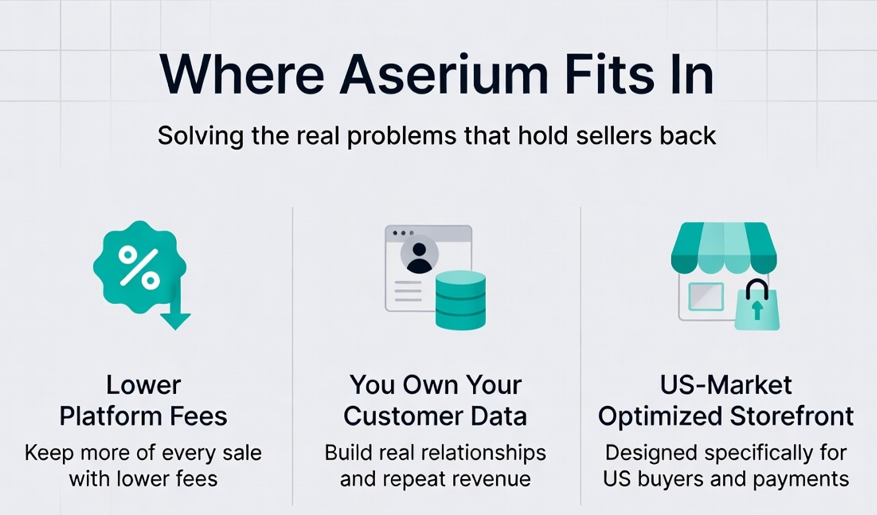
Aserium is designed to address exactly these pain points. Lower platform fees, seller-owned customer data, and a US-market-optimized storefront help sellers shift from margin-eroding marketplace dependency to a model that actually scales.
Pricing Strategies That Actually Work for Ecommerce Sellers
Different business models and product types call for different approaches. Here are the four most effective, and when to use each one:
| Strategy | How It Works | Best For |
| Cost-Plus Pricing | Add a fixed margin on top of total costs | Commoditized products, high-volume sellers |
| Value-Based Pricing | Price based on perceived value to the buyer | Differentiated products, premium brands |
| Competitive Pricing | Price relative to direct competitors | Highly competitive categories, price-sensitive markets |
| Premium / Prestige Pricing | Set a higher price to signal quality and exclusivity | Branded goods, niche luxury, D2C brands |
Which Strategy Should You Use?
Most mature ecommerce businesses use a hybrid strategy. Start with cost-plus to set your floor (the minimum price that preserves your target margin), then apply value-based or competitive logic to set your ceiling and market position.
One important thing: Do not compete purely on price. It’s a race to the bottom that no independent seller wins against mega-retailers with unlimited logistics budgets. Sellers who move from marketplace to D2C often discover that value-based and premium pricing suddenly become viable, because they now control their brand presentation, story, and customer experience.
Ecommerce Profitability Benchmarks: What “Good” Actually Looks Like
What profit margin should you be targeting? It depends on your channel and category, but here are widely used benchmarks to calibrate against:
| Selling Model | Gross Margin Target | Net Margin Target | Notes |
| Amazon FBA (Marketplace) | 25-40% | 5-15% | High fees compress net margins |
| Walmart / Target Marketplace | 25-40% | 8-18% | Lower ad costs vs. Amazon |
| Own Website (D2C) | 40-60% | 15-30% | Lower fees, higher LTV potential |
| Independent Platform (e.g., Aserium) | 40-60% | 18-35% | Optimized for US market D2C |
| Wholesale / B2B | 20-35% | 10-20% | Volume-driven, lower per-unit margin |
When to Scale vs. When to Optimize
If your net margin is below 10%, do not scale yet. Scaling a low-margin business only amplifies the losses. Focus on reducing costs, improving conversion rates, and auditing your fee structures before putting more money into growth.
If your net margin is consistently above 20%, you have something worth scaling. That’s when to invest in advertising, expand your catalog, and explore new channels.
How Selling Independently Improves Your Profitability
The case for diversifying away from pure marketplace dependence has never been stronger and it’s fundamentally a profitability argument, not just a branding one.
What Changes When You Sell Independently
- Control over pricing: No algorithmic price-matching, no mandatory promotions, no pressure to race toward zero.
- Lower per-transaction fees: Independent platforms typically charge a fraction of marketplace commissions, directly improving your ecommerce profit margin.
- Customer data ownership: You collect emails, purchase history, and behavioral data, making repeat purchases possible at near-zero CAC.
- Better Lifetime Value (LTV): Research from Harvard Business Review shows that direct-to-consumer customers have a 3-5x higher lifetime value compared to marketplace buyers, driven by repeat purchase rates and the ability to personalize your outreach.
- Brand equity: Your store, your story, your experience. That translates directly into pricing power and customer loyalty.
How Aserium Fits In
Aserium is purpose-built for sellers who want to establish or grow a profitable presence in the US market without the margin compression that comes with marketplace dependency. As a seller hub designed specifically for the US ecommerce landscape, Aserium offers a storefront optimized for US buyers and payment methods, lower fee structures designed to protect your margins, tools for managing pricing, inventory, and customer data in one place, and a platform built for scalable, independent selling.
For sellers thinking seriously about marketplace vs D2C profit, Aserium is a practical path to capturing more of what you actually earn.
Actionable Checklist: Fix Your Ecommerce Pricing Today
Use this to audit your current pricing model and find the fastest paths to better ecommerce profitability:
- Calculate your true total costs. Include COGS, shipping, platform fees, marketing, and returns. Leave nothing out.
- Set a target net margin. Define the minimum your business needs to be sustainable (typically 15-25% for D2C, 10-15% for marketplace).
- Audit your marketplace fees. Pull a full fee report for the last 90 days. Find where fees have risen or margins have quietly compressed.
- Apply the pricing formula. For every SKU, verify that your selling price covers all costs plus your target margin.
- Review your discount dependency. Which promotions are driving real volume, and which are just training customers to wait for a sale?
- Measure your return rate by category. High-return categories need tighter product descriptions, better sizing guides, or repricing that accounts for return costs.
- Explore independent selling channels. What percentage of your revenue comes from channels you own? Set a target to grow that number over the next 12 months.
- Track profitability by channel. Not all revenue is equal. Break down your net margin by marketplace, D2C, and wholesale to see where your money is actually coming from.
Conclusion: Profit Over Revenue. Every Time.
Building a thriving ecommerce business in the US market is not about who generates the biggest revenue figure. It’s about who builds the most resilient, profitable operation and that starts with how you price.
The sellers who will thrive over the next five years are not the ones chasing marketplace volume at any cost. They’re the ones who know their numbers, protect their margins, diversify their channels, and invest in direct customer relationships.
Ecommerce pricing for sellers is not a one-time exercise. It’s an ongoing discipline. Revisit your costs every quarter. Benchmark your margins. Adapt your strategy as the market evolves. Use this guide as your foundation and keep coming back to it as your business grows.
Ready to Stop Giving Marketplaces a Cut of Everything You Earn?
You’ve done the hard work to get sales. Now it’s time to keep more of what those sales are worth.
Aserium is built for US ecommerce sellers who are done leaving money on the table. Lower fees. Your customer data. Hybrid AI. Your own storefront that works for the US market. All in one place.