
Many ecommerce sellers believe the fastest way to grow profit is by increasing sales.
But in reality, reducing unnecessary costs is often faster, easier, and more sustainable than constantly chasing higher revenue.
Why?
Because every dollar saved goes directly back into your profit margin.
If your business improves operational efficiency by just 5–10%, the impact on profitability can be significant without increasing ad budgets or acquiring more customers.

This is why successful ecommerce businesses focus not only on growth, but also on profit optimization.
The goal is not simply generating more orders. The goal is building a healthier business with stronger margins, better cash flow, and long-term sustainability.
In this guide, we will break down practical ecommerce profitability tips sellers can use to reduce ecommerce costs, improve operational efficiency, and increase ecommerce profit margins without relying entirely on higher sales volume.
How Can Sellers Reduce Ecommerce Costs and Increase Profit Margins?
Ecommerce sellers can improve profitability by:
- Reducing product and supply chain costs
- Lowering shipping and fulfillment expenses
- Eliminating advertising waste
- Improving operational efficiency
- Increasing average order value (AOV)
- Reducing marketplace fee dependency
- Using profitability-focused tools and automation
Small improvements across multiple areas often create larger profit gains than simply increasing sales volume.
Understand Your Ecommerce Cost Structure
Before reducing costs, sellers must understand exactly where their money is going.
Many ecommerce businesses underestimate operational expenses, which leads to shrinking margins over time.
Ecommerce Cost Stack
| Cost Category | Common Expenses |
| COGS | Manufacturing, sourcing, packaging |
| Shipping & fulfilment | Warehousing, last-mile delivery |
| Marketplace Fees | Referral fees, FBA fees, commissions |
| Payment Processing | Credit card and transaction fees |
| Advertising | Google Ads, Meta Ads, Amazon PPC |
| Returns & Refunds | Reverse shipping, damaged inventory |
| Overhead | Software, staff, customer support |
When combined, these expenses can consume a large percentage of revenue.
Understanding this full cost structure is the foundation of improving profitability.
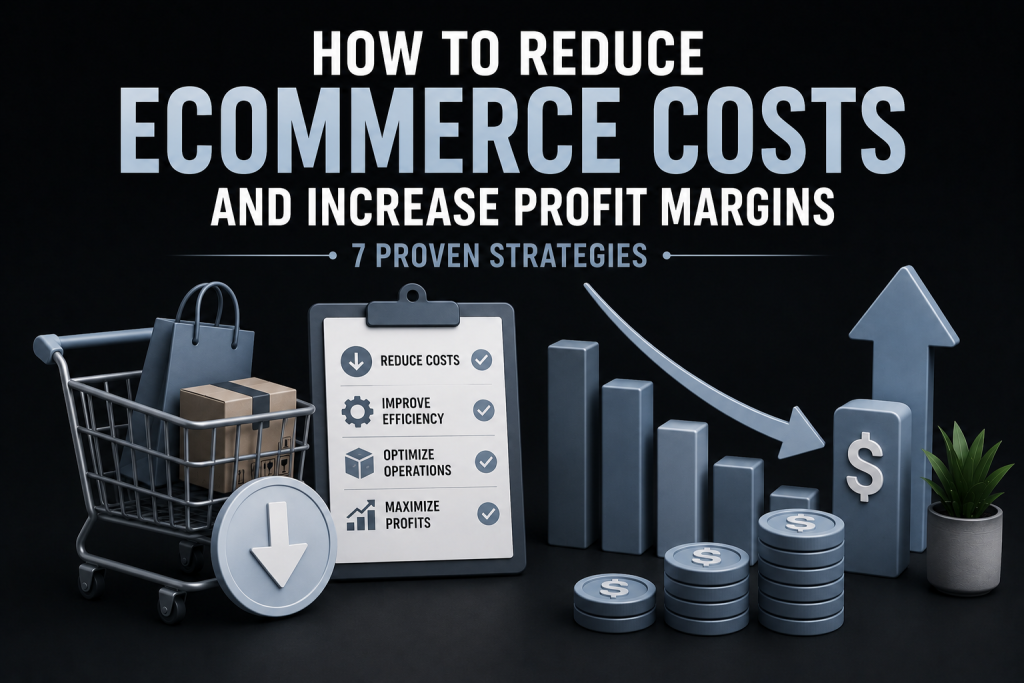
Strategy 1: Reduce Product & Supply Chain Costs
Product sourcing and inventory costs directly impact profit margins.
Consider these cost-saving opportunities:
- Negotiate better supplier pricing
- Secure volume discounts on fast-moving products
- Improve payment terms
- Optimize packaging materials
- Consolidate freight shipments where possible
Even modest reductions in sourcing costs can significantly increase ecommerce profit margins over time.
Strategy 2: Lower Shipping & Fulfillment Expenses
Shipping is often one of the largest operating expenses for ecommerce sellers.
To reduce fulfillment costs:
- Review 3PL pricing regularly
- Compare carrier rates
- Use regional warehousing when practical
- Automate shipping workflows
- Reduce dimensional weight through smarter packaging
Lower shipping costs improve profitability while helping maintain competitive pricing for customers.
Strategy 3: Reduce Advertising Waste
Advertising can drive growth, but inefficient campaigns quickly erode margins.
Focus on improving return on ad spend (ROAS) by:
- Eliminating underperforming campaigns
- Improving audience targeting
- Strengthening retargeting efforts
- Testing creative variations
- Tracking product-level profitability
Remember, more ad spend does not always equal more profit.
Email marketing, customer retention campaigns, and organic traffic can often generate stronger long-term returns than continuously increasing advertising budgets.
Strategy 4: Improve Operational Efficiency
Operational inefficiencies create hidden costs that many sellers overlook.
Look for opportunities to:
- Automate repetitive tasks
- Improve inventory forecasting
- Reduce stockouts and overstocks
- Streamline order management
- Simplify internal workflows
Efficient operations reduce waste, improve customer satisfaction, and help protect profit margins as your business grows.
Strategy 5: Increase Average Order Value (AOV)
Improving AOV is often easier than acquiring new customers.
Simple ways to increase AOV include:
- Product bundles
- Upsells and premium options
- Cross-sell recommendations
- Free shipping thresholds
- Volume discounts
For example, encouraging customers to spend $75 instead of $60 may significantly improve profitability without increasing marketing costs.
Higher order values also improve fulfillment and acquisition efficiency.
Strategy 6: Reduce Marketplace Fee Dependency
Marketplaces provide access to buyers, but they can also reduce profitability through:
- Referral fees
- Fulfillment charges
- Advertising requirements
- Pricing competition
- Limited customer ownership
Many successful ecommerce brands are balancing marketplace sales with direct-to-consumer (D2C) channels.
Benefits of D2C selling include:
- Better pricing control
- Stronger customer relationships
- Lower platform fees
- Higher repeat purchase potential
Platforms like Aserium help sellers expand their presence in the US market while reducing dependency on high-fee marketplace ecosystems and improving long-term margin potential.
Strategy 7: Use Profitability-Focused Tools
The right technology can help sellers identify inefficiencies and reduce costs.
Useful tools include:
- Inventory management software
- Shipping automation platforms
- Customer retention tools
- Analytics dashboards
- Advertising optimization solutions
These systems help sellers make better decisions, automate manual processes, and improve overall operational efficiency.
Investing in the right infrastructure often creates long-term cost savings and stronger profitability.
Common Ecommerce Profitability Mistakes
Many sellers unintentionally reduce profits by:
- Focusing only on revenue growth
- Ignoring customer retention
- Overspending on advertising
- Depending on a single marketplace
- Failing to monitor margins regularly
- Carrying excess inventory
Avoiding these mistakes can improve profitability without requiring significant changes to your business model.
Tools & Platforms That Help Sellers Save More
The right systems can significantly improve ecommerce operational efficiency.
Useful tools include:
- Inventory management platforms
- Shipping automation software
- Customer retention tools
- Analytics dashboards
- Advertising optimization platforms
Many sellers are also exploring independent ecommerce infrastructure that supports better profitability.
Platforms like Aserium are designed to help ecommerce sellers reduce marketplace fee dependency while providing better control over pricing, customer relationships, and operational scalability in the US market.
For sellers focused on long-term growth, profitability-focused infrastructure can create a major competitive advantage.
Conclusion
Improving ecommerce profitability is not always about generating more revenue.
In many cases, the biggest gains come from reducing waste, optimizing operations, improving customer retention, and strengthening profit margins across the business.
Small savings across shipping, fulfillment, advertising, and operational expenses can compound into significant long-term profit improvements.
The most successful ecommerce businesses are not necessarily those with the highest revenue. They are the businesses that consistently protect their margins and operate efficiently.
Ready to Build a More Profitable Ecommerce Business?
Aserium helps sellers reduce marketplace dependency, strengthen customer ownership, and build a more sustainable path to growth in the US ecommerce market.
Explore how Aserium can help you improve margins and grow smarter.
Frequently Asked Questions
-
Frequently Asked Questions
Businesses can reduce costs by optimizing sourcing, improving shipping efficiency, reducing advertising waste, automating operations, and using better inventory management practices.
-
What are the biggest costs in ecommerce?
Common expenses include product sourcing, shipping and fulfillment, advertising, marketplace fees, payment processing, returns, and operational overhead.
-
How can sellers improve profit margins without raising prices?
Improving average order value, reducing operational inefficiencies, lowering fulfillment costs, and increasing customer retention are some of the most effective strategies.
-
Why is marketplace dependency expensive?
Marketplace sellers often face referral fees, advertising costs, fulfillment charges, and limited control over customer relationships, all of which can reduce profit margins.