
Growth is not the same as control.
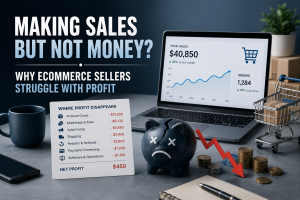
This is the lesson that thousands of marketplace sellers learn, sometimes painfully, after years of chasing volume on Amazon, eBay, or Walmart. Revenue goes up. Fees go up. Ad spend goes up. Complexity goes up. But actual business value? That often stays flat or quietly erodes.
This is the marketplace trap: the illusion of growth built on a foundation you don’t own, can’t control, and can lose overnight. For sellers who want to build something real, a brand, a customer base, a business worth acquiring or passing down, understanding this dynamic is the first step to escaping it.
What Is the Marketplace Trap?
The marketplace trap isn’t about selling on Amazon being inherently wrong. It’s about over-dependence on a single platform creating fragility that sellers often don’t notice until it’s too late.
Here’s how it works: a seller lists products, finds traction, scales volume, and reinvests profits into more Amazon ads to sustain that growth. The numbers on the dashboard look healthy. Revenue is climbing. But underneath, the economics are tightening with every cycle. More spend is required to maintain visibility. More competitors enter the same keywords. More fees absorb more margin. The business appears to be scaling, but it’s actually running faster on a treadmill it doesn’t own.

The illusion of growth is one of the most dangerous aspects of marketplace dependency. Sellers optimize for platform metrics like BSR (Best Sellers Rank) rank, review count, and Buy Box percentage that have no meaning outside of that single platform. When the platform changes, those metrics reset to zero.
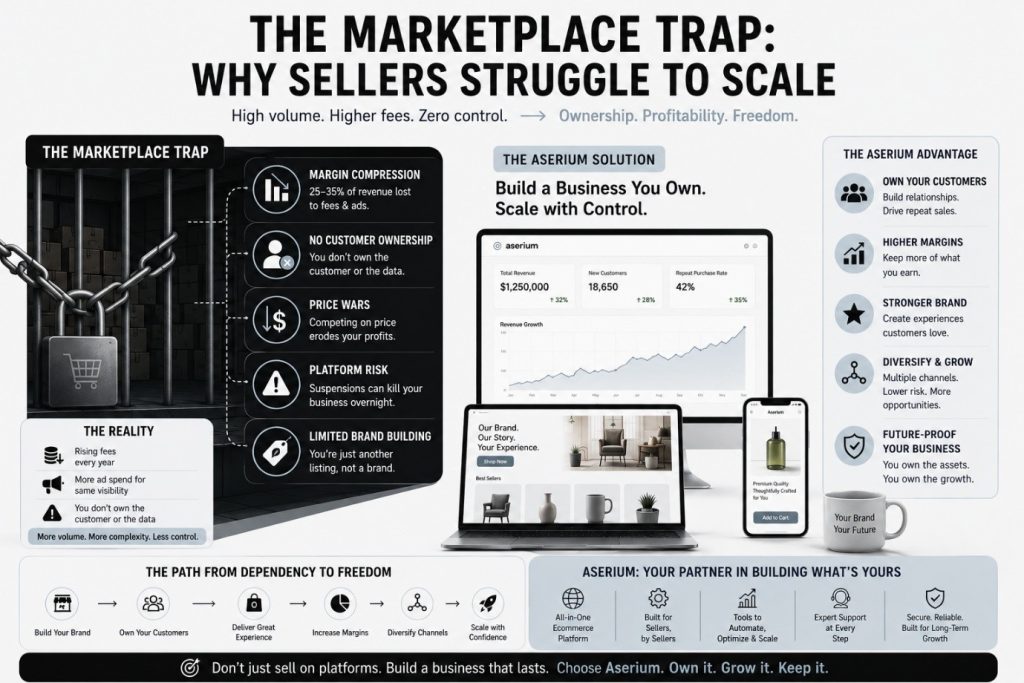
5 Hidden Barriers to Scaling on Marketplaces
1. Margin Compression
Amazon’s total fee burden, combining referral fees, FBA fulfillment, storage charges, low-inventory penalties, and advertising costs, now consumes 25–35% of revenue for the average FBA seller, with high-competition categories pushing closer to 40%. When 65% of Amazon sellers were forced to raise prices in 2024 due to fee increases, they weren’t gaining margin. They were attempting to preserve it. Scaling on Amazon means buying more of a product that costs more to sell on every unit.
2. No Customer Ownership
Every transaction on Amazon generates a customer record that belongs to Amazon, not the seller. Buyers can’t be re-marketed to directly. Email sequences can’t be built. Loyalty programs can’t function. The seller fulfills the order; Amazon retains the relationship. Without customer ownership, there is no retention strategy, and retention is the single biggest lever for sustainable ecommerce economics. A business that can’t retain buyers must constantly buy new ones, driving customer acquisition costs permanently higher.
3. Price Wars
Marketplace environments are inherently competitive on price. When dozens of sellers list similar products in the same category, buyers sort by lowest price and the algorithm rewards the winner with more visibility, which attracts more competitors. This race to the bottom doesn’t end; it simply grinds margins until weaker sellers exit and stronger ones barely survive. Brands that try to hold premium pricing without differentiated brand equity get systematically undercut. On a marketplace, your listing competes against every equivalent product on earth.
4. Platform Risk
Suspensions are not edge cases. They are a documented, widespread risk. In 2024, over 35% of Amazon sellers received a notice of violation, with mid-sized businesses in the $100K–$1M revenue range facing the highest suspension rates. In 2024, enforcement shifted from individual ASIN suspensions to full account deactivations, meaning one product compliance issue can shut down an entire business’s revenue stream instantly. Funds get frozen. Listings vanish. Cash flow halts. Sellers operating exclusively on Amazon carry this existential risk as a permanent, uninsurable overhead cost.
5. Limited Brand Building
A marketplace listing is not a brand. It’s a product entry in a database, formatted to platform specifications, ranked by an algorithm, and displayed next to competitors. There is no brand story, no differentiated experience, and no reason for a buyer to come back for you specifically rather than the next seller offering the same product at a slightly lower price. Brands are built through consistent, owned customer experiences, something marketplace templates are architecturally incapable of delivering.
Why Scaling on Marketplaces Becomes Hard Over Time
The barriers described above aren’t static. They compound. As a marketplace business grows, customer acquisition costs rise because the easy, low-competition search terms have been exhausted and every incremental sale requires higher ad spend to capture. Competition saturates the niches where early growth happened. Fees increase. The seller’s share of revenue shrinks even as gross volume climbs.
This dynamic explains why many Amazon sellers with $1M+ in revenue are generating less actual profit than sellers half their size operating outside the platform. Scale on a marketplace does not translate linearly into profitability. It often translates into more complexity, more overhead, and more exposure to risks that don’t diminish with size.
Real Impact on Business Valuation
Here’s where the marketplace trap has the most concrete, measurable consequence: at exit.
Sellers who want to sell their business discover that marketplace dependency heavily discounts valuation. According to reports, well-managed Amazon-dependent brands typically receive EBITDA multiples of 2.0x–3.0x, a ceiling that reflects the platform risk, customer ownership deficit, and margin fragility that buyers price in. Sellers exclusively dependent on third-party marketplaces face significant valuation limitations for larger deals, as the concentrated platform risk is too significant for many acquirers to absorb.
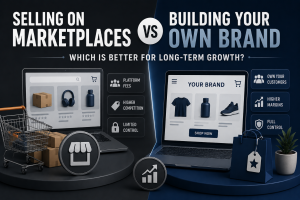
By contrast, D2C brands with owned audiences, strong retention, and diversified channels attract meaningfully higher multiples because they represent assets with defensible customer relationships and independent growth trajectories. The business built off-platform is worth more precisely because it doesn’t rely on someone else’s platform to exist.
The financial reality is blunt: a $500K profit marketplace business and a $500K profit D2C brand are not equivalent assets. The brand can often sell for 2–3x more.
Breaking Out of the Marketplace Trap
Escaping marketplace dependency doesn’t require abandoning the revenue channels that work today. It requires deliberately building alongside them.
Diversify channels in parallel.
Keep your Amazon presence while launching a second channel, a Shopify store, a social commerce account, or a structured platform. Every sale through an owned channel is a step toward reducing the revenue concentration that creates vulnerability.
Build a D2C foundation.
A basic storefront, an email capture mechanism, and a retention sequence represent the minimum viable brand infrastructure. These assets compound: an email list that grows by 100 people per month becomes a 1,200-person owned audience by year’s end, buyers you can reach without paying Amazon for permission.
For a deeper look at setting up your store, attracting customers, and growing sales across multiple channels, read our online selling guide for sellers.
Use platforms like Aserium as a bridge.
Not every seller is ready to build a full D2C stack from scratch, and that’s fine. Aserium provides a structured entry point with Brand Registry features, fulfilment support, and genuine buyer discovery that lets sellers establish an independent presence without the full overhead of a standalone Shopify buildout. It’s a practical starting point for sellers who want the benefits of independence without making an all-or-nothing infrastructure leap.
The path out of the marketplace trap is incremental, not dramatic. Pick one channel. Build consistently. Reduce concentration. Repeat.
Conclusion
The marketplace trap is seductive because it works in the short term, in the wrong direction. It grows revenue while shrinking control. It builds volume while eroding margin. It creates the appearance of a business while quietly preventing one from actually forming.
Control is the foundation of scalability. And control, in ecommerce, means owning your customers, owning your margins, and owning the channels through which your brand reaches the world.
Start building that ownership today. Aserium is a practical first step for sellers ready to move beyond the trap and start building something that’s genuinely theirs.
Ready to stop renting your growth and start owning it?
Never settle for less.