
Tired of watching fees devour your profits, suspensions kill your momentum, and zero customer data leave you starting from scratch every time? Here’s the ultimate guide to How to Sell Online in 2026, discover real marketplace alternatives, build d2c brand assets you actually own, sell globally online, and reduce marketplace dependency, while keeping way more of every dollar you earn.
We’ve been in this game a long time, helping hundreds of resellers, wholesalers, manufacturers, and D2C founders across the US navigate the exact same frustrations you’re probably facing right now.
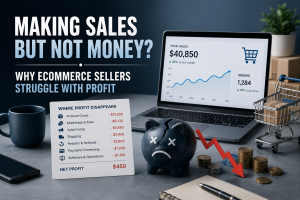
You know the feeling: another strong sales month, only to watch a massive chunk of your revenue disappear into fees, storage, and ads. Or worse, waking up to a suspension notice that freezes your entire business overnight.
You’re not failing. The system is built to keep you dependent.
That’s why more smart sellers are actively searching for ways to sell online, explore real marketplace alternatives, build d2c brand assets they actually own, sell online, and finally reduce marketplace dependency.

This guide is for you. Ready to stop renting your business and start owning it?
Why Relying on One Platform Is a Business Risk
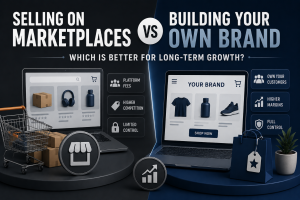
If your entire revenue runs through a single marketplace, you don’t own a business – you rent space in someone else’s ecosystem.
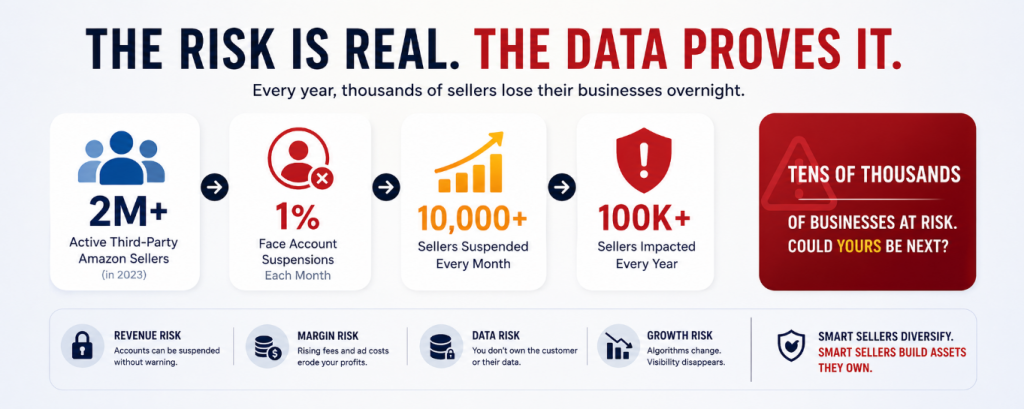
That might sound harsh, but the data backs it up. In 2023 alone, industry reports estimated that tens of thousands of Amazon seller accounts were suspended or banned, many without prior warning. They reported that approximately 1% of active Amazon sellers face account suspensions each month. With roughly 2 million+ active third-party sellers at the time, this equals tens of thousands of suspensions per month – easily hundreds of thousands over the full year.
Sellers who had built six- and seven-figure operations saw their revenue disappear overnight with no appeal timeline and no recourse for inventory stuck in warehouses.
We’ve seen it happen too many times to count. One week you’re crushing it; the next you’re staring at a “your account has been suspended” email and wondering how you’re going to pay your team.
Today, many sellers are actively looking for ways to sell in US without amazon, explore reliable marketplace alternatives, and build d2c brand assets that give them full control over pricing, customer relationships, and long-term growth.
This guide will show you how to build a scalable, independent selling system – one that you own, control, and can grow on your own terms.
Whether you are an established marketplace seller looking to reduce marketplace dependency, an international brand trying to sell online globally, or an entrepreneur exploring how to sell in US without amazon, this guide covers every stage of the journey: from validating your first independent sale to building a resilient, multi-channel brand.
What Does It Mean to Sell Online in 2026?
Selling online in 2026 is no longer just about listing products on a marketplace and waiting for orders. Today’s most successful ecommerce businesses use a combination of sales channels, customer acquisition strategies, and operational systems to create sustainable growth.
Whether you’re launching your first online store, expanding beyond a single marketplace, or building a multi-channel ecommerce business, success depends on owning your customer relationships, maintaining healthy profit margins, and adapting to changing consumer behavior.
Modern online sellers leverage a mix of:
- Ecommerce websites
- Online marketplaces
- Social commerce platforms
- Search-driven sales channels
- Email and customer retention marketing
- Strategic fulfillment and logistics solutions
The goal is not simply to generate sales it’s to build a profitable, scalable ecommerce business that can grow regardless of changes in any single platform or channel.
Who This Guide Is For
This guide is designed for:
New Ecommerce Entrepreneurs
Individuals looking to launch an online business and choose the right selling channels from the start.
Marketplace Sellers
Businesses seeking to diversify revenue streams and reduce dependence on a single platform.
Direct-to-Consumer (DTC) Brands
Brands focused on building customer relationships, increasing lifetime value, and strengthening brand ownership.
Growing Ecommerce Businesses
Companies looking to improve profitability, streamline operations, and scale across multiple sales channels.
International Brands Entering New Markets
Businesses expanding their online presence and looking for effective ways to reach customers in competitive ecommerce markets.
What You Will Learn
By the end of this guide, you’ll understand:
- How online selling has evolved in 2026
- The most effective channels for selling products online
- How to choose the right ecommerce platform for your business
- The advantages and challenges of marketplaces, DTC websites, and multi-channel selling
- How to attract and retain customers in a competitive market
- Strategies for improving ecommerce profitability
- Common online selling mistakes and how to avoid them
- How to build a scalable ecommerce business that can grow over time
- Key metrics every online seller should track
- A practical step-by-step checklist for launching or growing your ecommerce business
Why Marketplace Dependency Is a Business Risk in 2026
The appeal of big platforms is obvious: instant access to 300 million active customers, a built-in logistics network, and a proven buying process.
- Revenue Risk
Your account can be suspended at any time for a policy violation, a competitor complaint, or even a system error. When it happens, all revenue stops instantly. Sellers with 100% of sales on one platform have no backup, no customer list to reach, and no alternative channel to switch to.
- Margin Risk
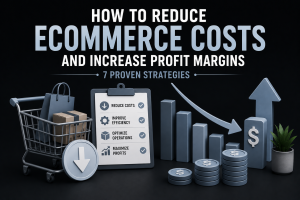
Platform fee structures have grown significantly more complex and costly over the past five years. Here’s a realistic breakdown for a mid-range consumer product:
- Referral fee: 8–15% of sale price (category-dependent)
- Fulfillment fee: $3.22–$6.10+ per unit
- Storage fees: $0.87–$2.40 per cubic foot/month (and much higher for long-term)
- Advertising (PPC): Often 15–25% ACoS (Advertising Cost of Sales) just to stay visible
On $1,000,000 in Gross Merchandise Value, many sellers realistically net only $150,000–$250,000 after fees, ads, COGS, and returns, a 15–25% margin. That same seller, moving through their own storefront with direct traffic, could retain 35–55% margins.
These rising costs are one of the main reasons sellers look for ways to sell in US without amazon and improve profitability.
- Data Risk
The platform owns the customer, not you. No email addresses, no purchase histories, no behavioral data. You cannot retarget, cannot upsell, cannot build real loyalty. If you ever leave, you start from zero with no audience. Without data ownership, it becomes nearly impossible to build d2c brand equity or create long-term customer value.
- Growth Risk
As platforms get more crowded, staying visible requires ever-increasing ad spend. Organic rankings become harder, algorithms favor deep-pocketed brands, and independent sellers with thin margins get squeezed out.
The sellers who build long-term value are those who reduce marketplace dependency, not those who go deeper into it.
This is exactly why more resellers and wholesalers are shifting toward marketplace alternatives and independent models.
Why the US Market Is Still a Massive Opportunity
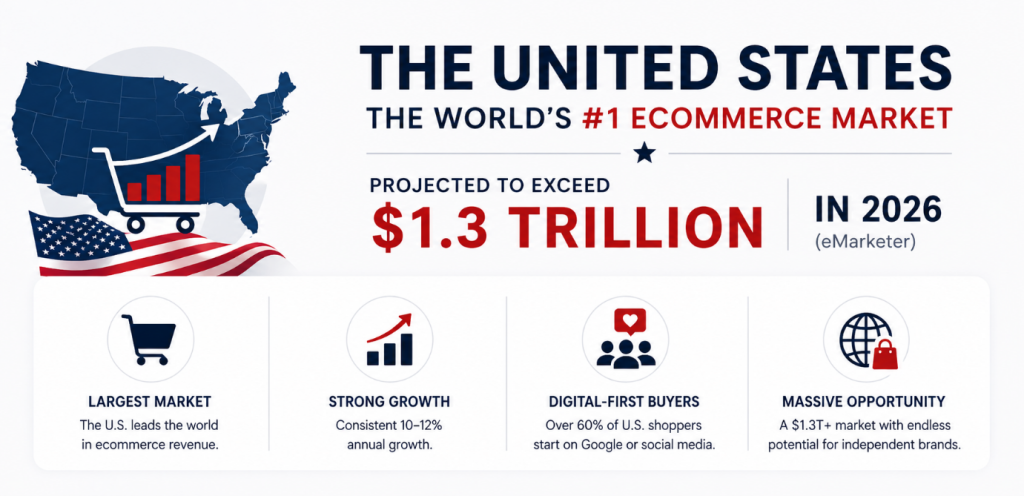
The United States remains the single largest ecommerce market globally by revenue, projected to exceed $1.3 trillion in 2026 (eMarketer).
More importantly for independent sellers, buyer behavior has shifted dramatically in favor of brands over platforms.
US Ecommerce Growth Overview
Growth has stabilized into a steady 10–12% annual expansion. While overall numbers have moderated post-pandemic, direct-to-consumer channels have dramatically outperformed marketplaces in profitability – D2C brands often retain 2–3x more profit per sale than equivalent marketplace listings.
Shift in Buyer Behavior: Brand-First Shopping
Over 60% of US online shoppers now begin their product search on Google or social media rather than a single marketplace. If a buyer searches for your product and lands on your site, you own that transaction completely: the data, the relationship, and the margin.
The Rise of Multi-Channel Shopping
Today’s US buyer discovers a product on TikTok, read reviews on Google, compare prices on a brand website, and then purchase through Instagram checkout. Shoppers are loyal to brands and experiences, not platforms.
Buyers no longer shop on one platform. They shop on multiple platforms, but they buy from brands they trust.
In 2026, the fastest-growing segment of US ecommerce is the cohort of brands that have built owned channels, customer lists, and multi-platform distribution. These sellers can sell globally online with the same infrastructure, scale into wholesale, and withstand algorithm changes that would devastate a pure-marketplace seller.
5 Proven Ways to Sell in the US Without Amazon
There is no single right answer. The best path depends on your product type, available capital, operational capacity, and growth goals. Here are five proven models, each with a full breakdown.
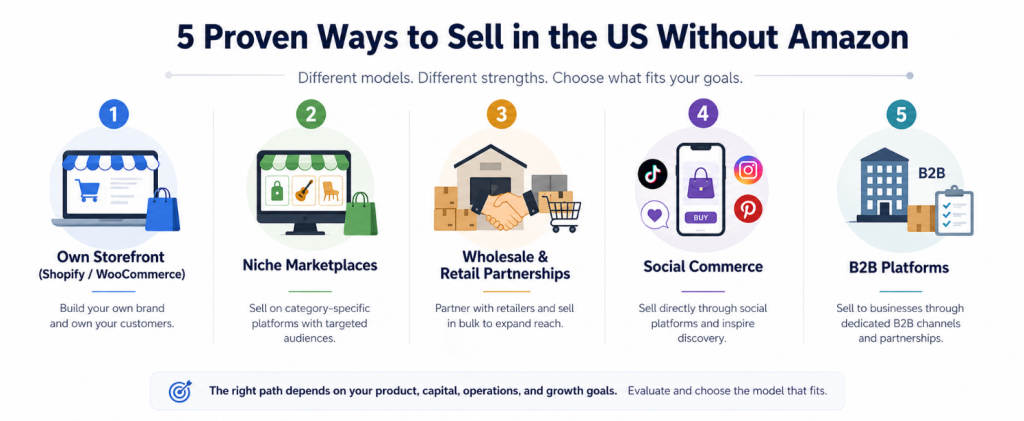
Model 1: Own Storefront (Shopify / WooCommerce)
You build and own your ecommerce website.
- Who it’s for: Sellers ready to invest in brand-building and long-term customer ownership.
- Setup difficulty: Medium (setup, design, traffic generation).
- Cost estimate: $29–$299/month for Shopify; lower for self-hosted WooCommerce.
- Time to first sale: 2–8 weeks depending on traffic strategy.
- Pros: Full brand control, 100% customer data, no listing fees, unlimited customization.
- Cons: You drive your own traffic.
This is the most effective approach to build d2c brand equity and reduce marketplace dependency.
Model 2: Niche Marketplaces
Selling on category-specific platforms (Etsy for handmade/vintage, Reverb for music gear, Faire for wholesale, Houzz for home, etc.).
- Who it’s for: Sellers with niche products that have a natural home on a vertical platform.
- Pros: Built-in targeted audience, lower competition, category trust.
- Cons: Limited brand control, platform dependency still exists (just smaller scale).
These platforms act as strong marketplace alternatives with more targeted audiences.
Model 3: Wholesale & Retail Partnerships
Selling your products in bulk to retailers who then resell to end customers.
- Who it’s for: Brands with proven demand looking to expand distribution without heavy direct D2C marketing costs.
- Pros: Large volume potential, strong brand visibility, reduced marketing spend.
- Cons: Lower margins, loss of end-customer data.
Model 4: Social Commerce
Selling directly through social media platforms (TikTok Shop, Instagram Shopping, Pinterest Buyable Pins).
- Who it’s for: Brands with visual products and an existing or buildable social audience.
- Pros: Discovery-driven sales, viral potential, low listing friction.
- Cons: Algorithm dependency, short content lifespan.
Social commerce is one of the fastest-growing ways to online selling globally, especially for new brands.
Model 5: B2B Platforms
Selling to businesses through dedicated B2B channels or direct outreach.
- Who it’s for: Manufacturers, wholesalers, or brands targeting business buyers.
- Pros: High average order values, repeat purchase potential, scalable without high ad spend. Cons: Longer sales cycles, heavy documentation.
The Infrastructure You Need to Sell in the US
To successfully sell in US without amazon, you need a strong operational foundation. None of this needs to be complex, but it does need to be in place before you launch.
Legal Setup
Most international sellers use a Limited Liability Company (LLC). It limits personal liability and is required by many payment processors. Wyoming and Delaware are popular for low fees. Services like Stripe Atlas, Firstbase, or Doola handle registration remotely for $150–$500.
Payment Systems
Stripe integrates with nearly everything. Wise Business and Payoneer are excellent for receiving funds without a US bank account. Mercury and Relay are built specifically for ecommerce businesses.
Logistics and Fulfillment
Partner with a US-based 3PL (ShipBob, Whiplash, Rakuten Super Logistics, etc.) for warehousing, pick-and-pack, and shipping. Most integrate directly with major platforms so orders flow automatically.
Returns Management
The average return rate across categories is 20–30%. Your 3PL (Third-party logistics) can handle processing. A clear, generous returns policy is one of the strongest trust signals for a new brand.
Sales Tax Basics
Since the 2018 South Dakota v. Wayfair ruling , you must collect sales tax in states where you have economic nexus ($100,000 in sales or 200 transactions per year per state). Tools like TaxJar or Avalara automate collection, filing, and remittance.
Customer Support Setup
US customers expect fast, professional support. A 24–48 hour response time is the minimum. As you scale, Gorgias, Freshdesk, or Zendesk let you manage everything from one dashboard. Even a part-time VA can dramatically improve satisfaction.
Building a Brand for US Customers
If your goal is to build d2c brand equity, trust and customer experience are your biggest growth drivers.
US consumers have been spoiled by fast shipping and easy returns, but they’re willing to pay more and wait longer for brands they trust.
Trust Signals
- Even 10–20 authentic reviews can significantly increase conversion rates. Use post-purchase emails to request them.
- A 30-day satisfaction guarantee reduces buyer risk.
- Clear, visible policies (shipping timelines, returns, contact info) build instant credibility.
- Social proof through UGC, press mentions, and micro-influencer partnerships works wonders.
Product Localization
- Always display prices in USD.
- Use US English (color, not colour).
- Provide US size charts for apparel and footwear.
- Use lifestyle photography that reflects a US audience.
Building Social Proof from Scratch
Offer discounted or early-access product to a small group in exchange for honest reviews. Run micro-influencer campaigns (10k–100k followers in your category). Seed your social channels with high-quality content before launch so you look established from day one.
Choosing the Right Platform – Where Should You Sell?
Most sellers fail not because they have a bad product, but because they choose the wrong channel. The right platform depends on fees, brand control, traffic access, and support.
Here’s how the major options compare:
| Feature | Traditional Platforms | Own Store | Niche Marketplace | Aserium Platform |
| Fees | High (8–45%) | Low | Medium | Optimized |
| Customer Data | No | Yes (Full) | Partial | Yes (Full) |
| Competition | Very High | Controlled | Medium | Curated |
| Brand Control | Low | High | Medium | High |
| Traffic | Built-in | Self-driven | Niche Audience | Supported |
| Support | Limited | Platform-based | Varies | Dedicated |
A seller on a traditional platform is optimizing for someone else’s algorithm. A seller on their own store (or a smart hybrid) is optimizing for their customer. These are fundamentally different strategies with different long-term outcomes.
Aserium is designed specifically for sellers who want to sell online with full control in the US market. Unlike traditional marketplaces, Aserium prioritizes brand growth over race-to-the-bottom pricing, gives you full access to your customer data, and supports you with dedicated onboarding and compliance guidance. Built for resellers and brands who are ready to move beyond marketplace dependency.
Unlike traditional platforms, Aserium prioritizes brand growth over race-to-the-bottom pricing. It gives you full ownership of your customer data, dramatically better margins, and a unified tech stack that replaces expensive custom tools.
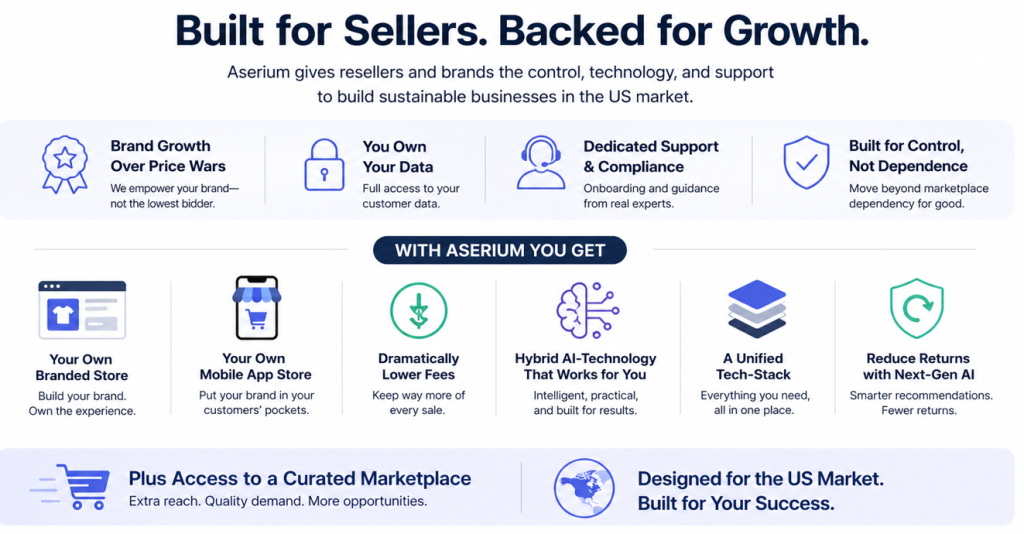
With Aserium you get:
- Your own branded store
- Your own mobile app store
- Dramatically lower fees (keep way more of every sale)
- Hybrid AI-technology that actually works for you
- A unified enterprise-grade back-office (CRM, POS, ERP, logistics, analytics)
- A curated marketplace with zero cannibalization – Aserium never competes with you
- Tools to help reduce your product return rate with next-gen AI
At Aserium, we are building the commerce ecosystem the world has been waiting for – where profit is shared, choice is respected, and relevance finally rules.