
Amazon Is Powerful. But It Shouldn’t Be Your Entire Strategy.
Amazon remains one of the largest eCommerce channels in the United States and for many brands, it’s an important part of their growth strategy.
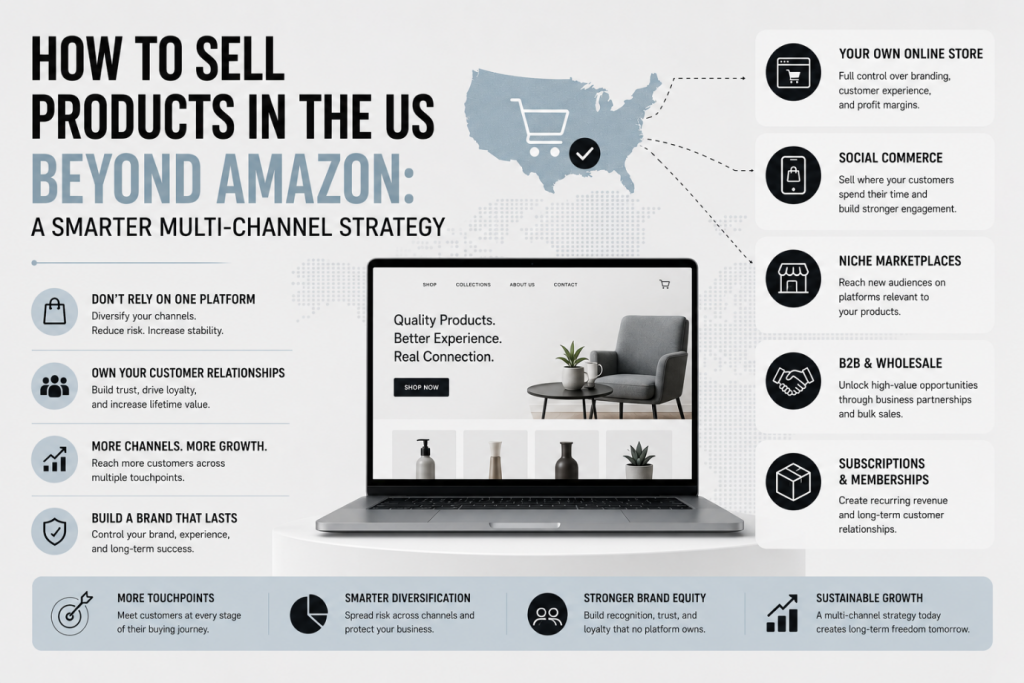
But relying on a single marketplace can limit your ability to build customer relationships, control your brand experience, and diversify revenue.
Today’s fastest-growing businesses combine multiple sales channels including their own online store, social commerce, niche marketplaces, and B2B partnerships.
This guide explains how to build a stronger US sales strategy by expanding beyond a single platform and creating more opportunities to reach American buyers.

Can You Really Sell Products in the US Without Amazon?
The short answer: yes.
Thousands of brands generate consistent US revenue through their own online stores, niche marketplaces, social commerce, and B2B channels without ever listing on Amazon.
Many sellers start on Amazon but eventually discover the challenges of platform dependency, shrinking margins, and limited customer ownership. Understanding the marketplace trap that prevents sellers from scaling sustainably can help you build a more resilient growth strategy from the start.
The key difference is that selling without Amazon requires a system, not just a product listing. You need to control discovery, trust-building, payment collection, and fulfillment yourself. It’s more work upfront, but it gives you something Amazon never will: a real customer relationship and a defensible business.
Step-by-Step Process to Start Selling in the US
Step 1 – Validate Demand in the US Market
Before spending a dollar on inventory or setup, confirm that US buyers are actively looking for what you sell.
Tools to use:
- Google Trends: Compare search interest across the US by region, season, and category
- Keyword research tools (Ahrefs, Semrush, or free alternatives like Ubersuggest): Find high-intent keywords with commercial signals like “buy,” “best,” or “near me”
- Reddit and Quora: Read real buyer conversations to understand pain points and language
Look for niches where search volume is steady or growing, competition from big-box retailers is limited, and buyers are asking specific questions. That specificity is your entry point.
Step 2 – Choose the Right Selling Model
Not every product or seller needs the same setup. If you’re still evaluating your options, our complete guide to online selling breaks down the different channels, business models, and growth strategies available to modern ecommerce sellers.
There are three primary models to consider:
| Model | Best For | Trade-off |
| Own Store (D2C) | Brand-building, repeat buyers | Higher setup effort |
| Niche Marketplace | Category-specific discovery | Platform dependency |
| Structured Entry Platforms | Faster launch, less infra | Less customization |
If you’re new to the US market, starting on a structured platform like Aserium makes sense, as it bridges the gap between a full D2C store and marketplace dependency. This lets you launch with less infrastructure while still owning your positioning.
Decision framework:
If you have an established brand → go D2C first. If you’re testing a new product or market → start with a platform that gives you distribution without full build-out.
Step 3 – Set Up Payments and Currency
US buyers pay in USD. If you can’t accept USD seamlessly, you will lose sales.
Recommended payment infrastructure:
- Stripe: Best for D2C stores, integrates easily.
- Payoneer: Ideal for cross-border sellers receiving marketplace payouts.
- Wise Business: Low-fee USD accounts for international sellers managing currency conversion.
Make sure your checkout displays prices in USD, offers familiar payment methods (credit/debit cards, Apple Pay, Shop Pay), and has a clear return/refund policy visible before purchase. Trust at checkout is non-negotiable for US buyers.
Step 4 – Manage Shipping and Fulfillment
Shipping expectations in the US are set by Amazon Prime even if you’re not on Amazon. Buyers expect 3–7 day delivery at minimum, with free shipping now widely expected on orders above $35–$50.
Two main approaches:
- 3PL (Third-Party Logistics): Ship inventory to a US-based fulfillment partner (ShipBob, Deliverr, or a regional 3PL). They store and ship on your behalf. This is the fastest path to US-speed delivery without opening your own warehouse.
- Direct International Shipping: Viable for testing or low-volume, but expect longer transit times, customs friction, and higher cart abandonment. Not recommended as a long-term strategy.
If you’re serious about the US market, a 3PL investment pays off quickly in conversion rates and repeat purchase rates.
Step 5 – Launch Your First Sales Channel
Don’t wait until everything is perfect. Pick one channel, launch fast, and learn.
Quick-win starting points:
- TikTok Shop or Instagram Shopping: Effective for visual products; discovery is algorithm-driven, not search-dependent
- A Niche Marketplace: Relevant to your category (Aserium for structured multi-category entry)
One channel, executed well, will teach you more in 30 days than months of planning.
Best Channels to Sell Products in the US Without Amazon
Niche Marketplaces: Platforms like Etsy, Houzz, or Faire connect you with buyers already looking for specific product types. Lower discovery friction, but subject to platform rules.
Social Commerce: TikTok Shop, Instagram Shopping, and Pinterest Shopping allow product discovery within social feeds. Works especially well for impulse-driven or visually compelling products.
Aserium: A structured marketplace built for sellers who want a faster, lower-friction entry into the US market. Aserium complements existing sales channels by helping sellers reach new buyers in the US market without the complexity of building every component from scratch. It can work alongside Amazon, your own website, social commerce efforts, and other marketplaces as part of a broader growth strategy, giving you real product visibility without the heavy infrastructure requirement of building from scratch. It’s particularly useful for international sellers and growing brands testing US demand before scaling to a full owned-store model.
Common Mistakes to Avoid
Trying to replicate the Amazon strategy.
On Amazon, you win with reviews, keywords, and price. Outside Amazon, you win with brand story, trust, and community.
Ignoring localization.
US buyers are sensitive to currency, spelling (color vs colour), cultural references, and return policies. A store that feels “foreign” converts poorly. Localize your copy, pricing, and policies.
No trust signals.
No US address, no customer reviews, no clear return policy, no SSL certificate any one of these can kill a sale. Build trust infrastructure before spending on traffic.
How Aserium Simplifies US Market Entry and Supports Multi-Channel Growth
Building a full D2C presence in the US takes time, capital, and technical expertise. Aserium is designed to shorten that curve.
Instead of choosing between heavy Amazon dependency and building everything from scratch, Aserium offers a structured middle path. You get product visibility, buyer discovery, and a professional storefront without needing a full tech team or large upfront ad spend.
It’s especially useful for international sellers and growing brands who want to validate US demand, make their first sales, and build a real customer base before deciding whether to invest in a complete owned-store model.
Conclusion
The most successful brands in today’s US market don’t rely on a single sales channel.
They combine marketplaces, direct-to-consumer websites, social commerce, and strategic partnerships to create sustainable growth and reduce dependency on any one platform.
Whether you’re already selling on Amazon or just entering the US market, expanding your channel mix can help you reach more customers, build stronger brand equity, and create a more resilient business.
Aserium can be one of those channels helping you test demand, gain visibility, and grow your presence in the US market.
Expand Beyond Amazon. Reach More US Buyers with Aserium.
Never settle for less.